- | F. A. Hayek Program F. A. Hayek Program
- | Edited Book Series Edited Book Series
- |
Applications of Public Choice Theory to Public Policy
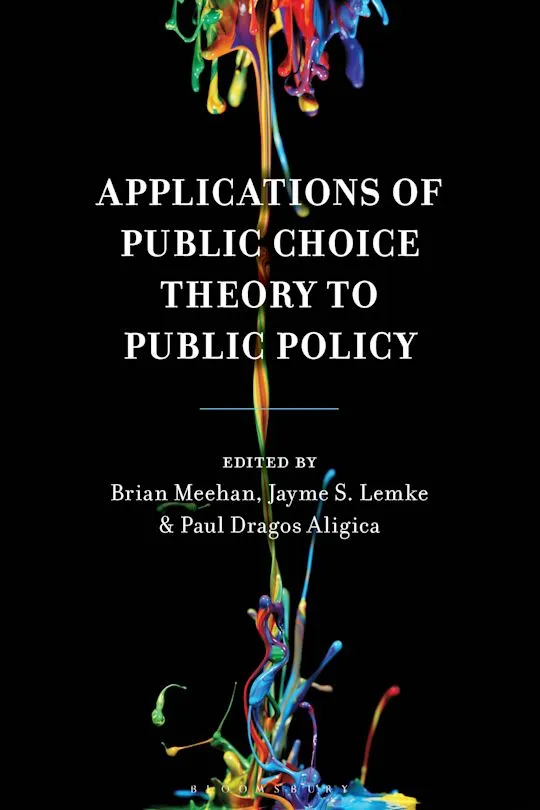
Purchase the book on Bloomsbury, Amazon, or Bookshop.org.
Published by Bloomsbury Publishing in Economy, Polity, and Society
The contributors to this book utilize the Public Choice approach to interpret, analyze, and at times even predict policy outcomes from a variety of contexts around the world. Applications of Public Choice Theory to Public Policy emphasizes how much can be learned from studying real people in the process of navigating political processes and institutional change. The volume directly addresses what the Public Choice approach is, its relationship to policy analysis, and how both can be improved through the incorporation of a diversity of theoretical and empirical strategies. After establishing these strategies, Applications of Public Choice Theory to Public Policy puts this into practice to address issues such as educational reform in Ghana, policy responses to the COVID-19 pandemic, anti-trust policy, the political role of the Supreme Court in the U.S. and high courts in Latin America, the impact of taking a precautionary approach to energy policy, regulatory burdens as a form of time tax, and the looming uncertainty over how artificial intelligence will be governed as it continues to have an ever greater impact on our lives.
Contents
Introduction
Brian Meehan , Jayme S. Lemke and Paul Dragos Aligica
Chapter 1: The Importance of Evidence-Based Narratives in Public Choice Theory
Brian Meehan
Chapter 2: Using Public Choice to Understand Historical Inequity in Disaster Planning and Response
Brittany K. Giles-Jones
Chapter 3: Unemployment Insurance Trust Funds Under Pressure
Dallin Overstreet
Chapter 4: Why Were There No Human Challenge Trials For Covid-19 Vaccine Development?
Malte Hendrickx
Chapter 5: Navigating the Path to Educational Progress
George Agyeah
Chapter 6: Employment Protections and Firm Size Distortion
Laura Montenovo
Chapter 7: Changing Antitrust Law
Cory Jack
Chapter 8: Public Choice v. Policy
Saige M. Hill
Chapter 9: Can Public Choice Theory Explain the Judicialization of Politics in Brazil?
Jean Vilbert
Chapter 10: Time Taxes and Avoidable Structural Injustice
Gah-Kai Leung
Chapter 11: AI and Governance
Agostina Lorenzini

