- | Regulation Regulation
- | Policy Briefs Policy Briefs
- |
The Economic Situation: September 2026
In his final report, Bruce Yandle asks if this is an unconventional golden age. Perhaps. AI and entrepreneurship may be reshaping the economy.
Getting Started
Each morning as we enjoy that first cup of coffee, we are greeted by a new economy. It is the result of decisions made and actions taken by billions of people worldwide. We look at concentrated bits of information, such as GDP growth, employment, and the Consumer Price Index, and attempt to assess the economic situation. At times, our assessments reflect the estimates and thoughts of countless other economy watchers, who, with their morning coffee, are also attempting to understand where the economy is headed. As suggested by John Maynard Keynes, sometimes we are like judges in a beauty contest who spend a lot of time trying to figure what other judges are thinking instead of focusing on those being judged!
I began my Economic Situation report in such a setting in the fall of 1984, 42 years ago. I had just returned to my Clemson faculty post after spending two years in Washington as executive director of the Federal Trade Commission. I was a member of the asset and liability committee of a regional bank. Our committee met early each Monday morning to assess the situation and, among other things, set interest rates to be charged and paid by the bank. I turned out a weekly Economic Situation report for the committee. From that experience, I learned that the exercise of looking at data together and talking about underlying tendencies is more important than just looking at the forecast numbers themselves. At the same time, the forecast numbers provided a starting point.
Shortly thereafter, I became a consultant to the South Carolina Board of Economic Advisors, and later I became a member and then chairman of the board. My Economic Situation report became less frequent, but it was also more extensive and more widely distributed. Now, as I turn 93 and the report turns 42, it is time to let the report rest for a while. I do this with a special note of appreciation to my readers and especially to the staff of the Mercatus Center, who, for quite a number of years, have produced the report and made it better.
How the report is organized
The report has four remaining sections. The next section focuses on GDP growth and includes a short review of what other judges are thinking and a discussion of how GDP growth spreads across the 50 states. The section that follows looks closely at how the Trump administration is treating favor-seekers and how this treatment fits with the Bootlegger and Baptist theory of regulation. The section ties the growth of favors granted to special interests to inflation and then examines recent comments made by the newly appointed Fed Chair, Kevin Warsh. The next-to-last section keys in on what has been called America’s “government habit” and then asks whether artificial intelligence (AI) may help to reduce the burden that comes with keeping the habit alive. Finally, the report concludes with three book reviews.
The Current Situation: GDP Growth
The current situation reflects a global disequilibrium among and within trading nations generated by fallout from the pandemic; the wars between Russia and Ukraine and in the Middle East; struggles over trade, petroleum, and critical mineral supplies; and the related efforts by major world powers to regain footing. Folded into all this is an AI, cloud-computing revolution. For the United States, the disequilibrium brings daily decisions—and often policy revisions—on tariffs, taxes, and deportations. It also brings threats to other countries and special deals for highly organized interest groups that are invited to sit in the Oval Office and formulate policies that will affect specific firms, industries, and sectors and the nation’s future. We are unusually challenged to explain what the year ahead may bring.
When we look at how all this may be distilled into real GDP growth, there’s a temptation to recall the words of an old song: “The old gray mare ain’t what she used to be!” Somehow those words seem like an appropriate description of the US economy as we approach 2026’s final quarter. The Department of Commerce has just delivered its second estimate for real GDP growth in the second quarter. The number, subject to future revision, came in at a weak 1.5 percent. Let’s take a closer look at how we got here.
Back in June, the US Department of Commerce gave an upward revision for the first quarter of 2026. The final estimate rose from 1.6 percent to 2.1 percent. (Maybe we will see an upward revision again.) We were back to running in the twos. (Recent annual real GDP growth was 2.1 percent in 2025, 2.4 percent in 2024, 3.4 percent in 2023, and 1.3 percent in 2022.) Although those numbers are hardly evidence of a new golden age, as promised by President Donald Trump, the data do tell us the Great American Bread Machine still works, perhaps in spite of what Washington does to it.
But why isn’t GDP at 3 percent? What happened to those 4 percent years in the 1980s and 1990s? Well, those were Baby Boomer years, when the labor force was growing and innovation was booming. We must remember that GDP growth is determined by adding labor force growth to growth in labor productivity.
Now, with almost zero native population growth, more than 250,000 undocumented immigrants deported since the start of the Trump administration, and 60,000 undocumented immigrants in detention centers awaiting deportation—factors affecting the number of people who go to work every day—as well as an aging population and more people taking retirement every day, the US labor force is experiencing negative growth, perhaps for the first time in a non-recessionary period.
This shrinking of the US labor force means that the burden for GDP growth rests on the shoulders of productivity gains, which fortunately, with AI assistance, hit 2.8 percent year-over-year in the first quarter of 2026. We might note that a low-growth economy has less room for dealing with the external shocks that might befall us and the required associated welfare payments or the political uncertainties and policy errors that always enter the mix. Even more noteworthy is that it is out of GDP growth that we pay off debt and past deficits. Unfortunately, we have a habit of spending more each year than we earn.
Expectations
Still, we best become accustomed to 2 percent growth. Table 1 provides GDP growth estimates for the next five quarters from the Philadelphia Fed, The Wall Street Journal, and Wells Fargo. A quick scan reveals little variation across time or forecast group. That said, we may find comfort in knowing that the Great American Bread Machine is not predicted to slip into negative growth territory.
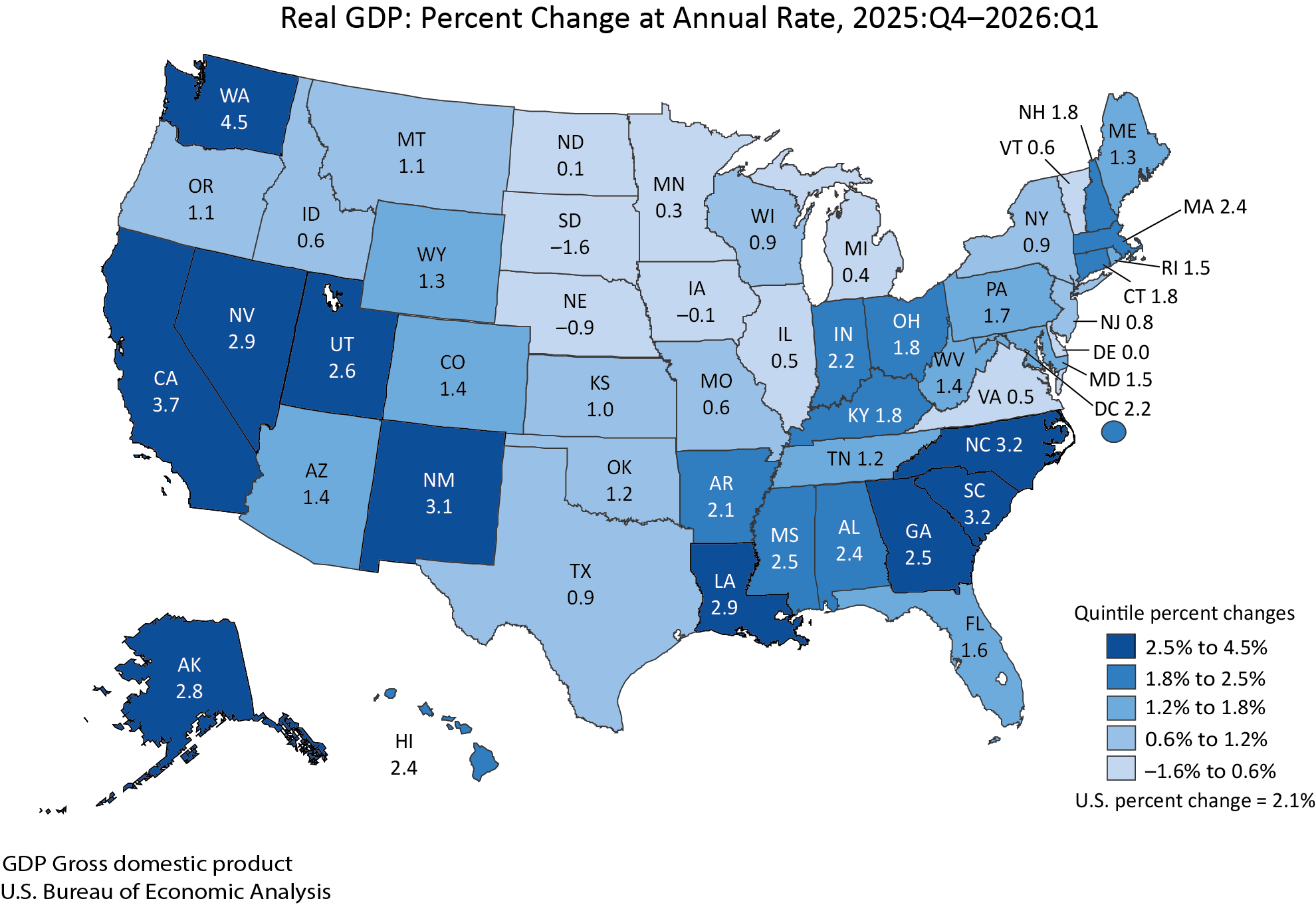
The next two charts speak to where GDP growth is occurring when the 50 states are considered. Figure 1 shows the annual growth rate for state GDP from the fourth quarter of 2025 through the first quarter of 2026. In terms of geographic patterns, the United States has higher growth in the west and southeast. Three states register negative growth: Iowa, Nebraska, and South Dakota.
We get a more extensive picture of state activity in figure 2, which reports growth in state coincident indicators for May and June 2026. While there are three or so weak states, generally speaking, prosperity is rather evenly spread across the country.
A Bootlegger–Baptist Jamboree and Resulting Inflation
What about this slow growth? When challenged about how the economy is doing and the fact that his promised golden age somehow remains offstage, Trump often points to the stock market and the fact that the Standard & Poor’s 500 and other financial market indicators have headed skyward. There’s no doubt about it, the 62 percent of Americans who own a piece of the economy by way of individual investments, 401(k)s, and other financial instruments have something to smile about. But our president surely knows that a booming stock market doesn’t necessarily mean the overall economy is booming. It is possible for White House policies to provide monopoly power to US firms, thus enabling them to raise prices, earn higher profits, and see higher stock prices, while the American people as a whole are getting poorer.
Trump has empowered himself with the ability instantly to invest in favored firms, impose tariffs on foreign-produced goods, or even ban the sale of specific products in the United States, thereby sharply altering the competitive landscape. Immediately, the share values of protected or otherwise favored firms tend to shoot toward the heavens and to stay up for a while. Eventually, of course, competitive forces erode the super-profits, and competitive returns prevail. But in the process, American consumers are left to pay more for less. Economists call the endless political play for profits favor- or rent-seeking behavior, and the constant parade of executives to the Oval Office tells us that favor-seeking is on the rise.
A recent Wall Street Journal story describes the now normal White House political action, where firms are welcomed openly to seek favors and can expect later to be asked for substantial donations to Trump-favored projects. The story mentions Amazon, Apple, Meta, Microsoft, Softbank, and other firms that have recently made multimillion-dollar donations. Another recent story highlighted efforts of rival auto producer Ford to secure competitive advantage by getting White House tariffs imposed on GM vehicles now imported to the United States from Korea, all in the name of national security.
It seems we have a veritable Bootlegger–Baptist jamboree on our hands. Firms that want subsidies or protection from competition—the bootleggers—welcome the support of political and other Baptists who appeal to national security and economic emergencies. These bootleggers are not trying to close corner liquor stores on Sunday but get tariffs and bans on foreign goods. Obviously, US soybean producers rejoice when Brazil is hit with high tariffs on agricultural exports. General Motors celebrates when tariffs are imposed on European-produced cars and when vehicles from China are banned. And US steel and aluminum producers can laugh all the way to the bank when high tariffs protect them from severe foreign competition.
Commenting on the unprecedented wide-open deal-making, Rice University presidential historian David Brinkley indicated: “The scope is mind-bogglingly wide. We used to talk about the Lincoln bedroom being for sale, but this is just a wholesale money trough that’s totally different.” But like the shared values that tend eventually to earn a competitive return, the bootleggers singing Baptist hymns will tend to spend up to the expected value of their gains in their pursuit. Thus, another form of waste enters the pictures. The ranks of the well-paid lawyers, economists, and others who park near the White House while seeking succor will expand. While rent-seeking may be fun and richly rewarded, it doesn’t lift the level of life for all members of society taken together. But does it figure into inflation?
Fed Chair Kevin Warsh says, “inflation is a choice.”
Newly appointed Fed Chair Kevin Warsh received lots of attention for an earlier Hoover Institution presentation that focused on monetary policy and inflation. Warsh argues that inflation represents a choice we make as a people. He emphasized a well-understood relationship in economics first clearly communicated by economist Irving Fisher in his 1911 book The Purchasing Power of Money. Formally focusing on the equation of exchange that describes a relationship between the nation’s money supply, the number of times that supply turns over, and nominal GDP, Fisher systematically argued that inflation is a monetary phenomenon. It is the result of things we do to ourselves. Other things being equal, when the amount of money circulating increases relative to the supply of goods, the price level inevitably rises. This means that deliberate decisions made by government officials to print money, expand debt, impose tariffs, bomb other countries and thereby reduce the flow of goods, or ease credit provide the springboard to a higher price level.
It is well to remember that the word inflation refers to increasing (or inflating) the money supply, which then leads to a higher price level. Kevin Warsh, widely recognized for his scholarly and administrative experiences, knows this, but he also knows that some major political forces are beyond the control of a Fed chair. He and his colleagues may decide to buy or sell government bonds for the Fed portfolio, which increases or reduces the supply of money, but they have no control over congressional actions taken to borrow more money and increase spending or over a president who decides to increase the price of most consumer goods by imposing tariffs on US imports. Perhaps, Keynes’s famous beauty pageant comment aside, this is why at the end of his first Federal Open Market Committee meeting as chair, Warsh recommended that those trying to figure out what the Fed is doing should focus on the ball, not the referees who poll each other regarding what they think will happen.
Warsh has stated that 2 percent inflation is his goal, and the latest numbers say he has a long way to go. The Federal Reserve's favored inflation gauge showed prices turned down a bit in June but remain uncomfortably above 2 percent. On a core basis, which excludes volatile food and energy prices, the July PCE clocked in at 3.3 percent. We see similar price-level changes when the Consumer Price Index is examined.
There may be a bit of psychology at play when energy and food are removed, and core inflation remains an ongoing 3.3 percent. Clearly, there are two elements here. Let’s call the first one “foreign made.” The energy surge is plainly the result of the Iran war as well as the effects of the ongoing effects of the Russia/Ukraine war. Of course, the Iran action was a decision made in Washington, but the surging relative price change was imported to our economy (and to all other economies) from abroad. The core inflation component is “homemade,” but let’s not get carried away with this nomenclature. Remember that there can be no inflation where all prices taken together increase, unless the amount of money circulating in the economy increases relative to the quantity of goods and services being processed.
When the federal government decides to spend more than it takes in with taxes and tariffs, we, as citizens, get to consume more than we produce. When the federal government sells bonds and prints money, the result is more dollars chasing a limited amount of goods and services available to us. All prices taken together tend to rise. That’s good old American homemade inflation. Deficits and growth in government debt to fund them make it happen. Economist Jonathan Hughes called this situation the “government habit.”
The Government Habit and AI
Data on growth in public debt, as shown in figure 4, and news that US public debt has just hit $40 trillion tell us that despite federal layoffs and shutdowns, the Trump administration is maintaining the Hughes habit. Figure 3 shows the explosion in debt that occurred when a lot of money was printed in association with COVID-19. This illustration is followed by figure 4, which maps growth in federal debt into the Personal Consumption Expenditures Index. Note the 7.2 percent inflation that followed in June 2022. That surge of newly printed money was chasing goods in a shutdown economy. A close look at the most recent four quarters tells us that deficits are growing; these data predict that homemade inflation will continue apace.
FIGURE 4. Debt and personal consumption expenditures index
Hardly a day passes without new announcements of high-tech and other layoffs attributed to the AI economy’s ability to replace and reshuffle workers.1 While the economists at the Bureau of Labor Statistics and other experts attempt to identify which forms of work are most vulnerable to the transformation, many of us also receive personal AI assistance in writing wills, planning investments, or completing complicated income tax returns, underscoring just how dramatically the world of work is changing. Others are using AI as a basis for starting a new business.
All of these changes affect GDP growth and how employment is measured in the economy. If we’re to fully understand what’s going on, we need to take a harder look at the data. When it comes to GDP, the wind that AI puts in our sails may come with a cross-breeze. Economists have long recognized that if a person marries their paid housekeeper or gardener and thus stops paying for the service while everything is cared for, GDP goes down. In other words, the economy as traditionally measured shrinks a bit. For the opposite reason, if a person places a cared-for family member in a nursing home, GDP rises.
Something similar happens when a person uses ChatGPT or another AI service for tax, medical, or even engine repair advice. As recently suggested by Oxford University economist Carl Frey, you might find yourself with less leisure time than if you’d visited the accountant, clinic, or mechanic. At the same time, the do-it-yourself AI approach subtracts from the earnings of businesses that previously provided the service. GDP growth as traditionally measured encounters a setback.
So we may marvel at what AI seems to be doing for free while failing to realize that we are ourselves doing more. Wouldn’t you know? Few things are truly “free” in this world.
As for small businesses and labor, in 2025, the US Chamber of Commerce found that 60 percent of small businesses are using AI for their core operations, which was double the amount reported two years earlier. AI activity is helping many of these firms to expand their commercial activities, and small business growth lies at the heart of the US economy.
There’s something else to consider: Many small businesses emerge because a person previously employed with another enterprise starts a new one. So, to understand the labor picture, we need to acknowledge the people moving from employed to self-employed, because they don’t show up in the Bureau of Labor Statistics employment head count that makes headlines each month. Just how large might their effect be in the current economy?
Last year, 5.6 million new businesses were formed. By comparison in US labor markets only 181,000 were added to US payrolls that year. While we don’t know exactly how many of the owners of all these new businesses were previously on a payroll, new business leadership has been larger than new hiring for years.
When we add the importance of AI to small business, as reported by the US Chamber of Commerce, the result strongly suggests that US employment growth, fully considered, is healthier than reported and that better things are eventually in store for the overall economy.
We need to dig deeper when seeing the latest GDP and employment growth numbers. Indeed, it would be helpful to all of us if the White House Council of Economic Advisers—those who annually write the “Economic Report of the President”—would give a quarterly assessment of the nation’s economic health, including the effect of the explosive growth in new business startups led by previously employed people.
Who knows? Maybe this really is America’s golden age, but not as traditionally measured.
Yandle’s Reading Desk
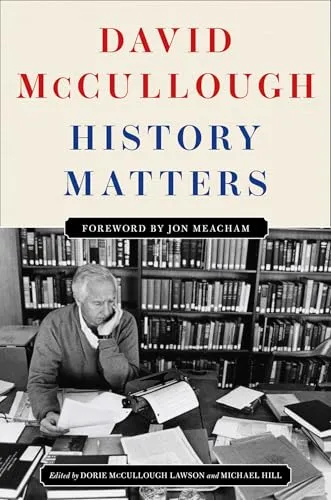
Often, if one is lucky, a book crosses the threshold that is simply a delight to read and think about. David McCullough’s History Matters (Simon & Schuster, 2025) is a case in point. A collection of speeches, columns, and commentary edited by his daughter Dorie Lawson and former assistant Michael Hill, the book communicates the essence of McCullough’s success as America’s leading storyteller.
A joy to read randomly or in sequence, the collection makes clear that McCullough, a recipient of the Presidential Freedom Award whose work was twice recognized with Pulitzers, was not just a historian. In fact, he emphasizes that he was not a historian, but an English major and a lover of the English language and words. But he was also a lover of history, and not just any history: He loved America and stories about America and Americans, and he wanted everyone else to feel the same way.
Early in the book, McCullough trumpets, “History shows us how to behave” and “reinforces what we believe in, what we stand for, and what we ought to be willing to stand up for.… Indifference to history isn’t just ignorant, it’s rude. It’s a form of ingratitude” (3). But history is more than this, as McCullough sees it. History is “an extension of life. It’s like poetry and art. Or music. And it’s ours to enjoy. (4)”
A creative genius himself, McCullough recognized that creativity was what separated the good among aspiring writers from the great. Not claiming to know how to bottle up creativity and open it when needed, McCullough has his own spark that shows up in several of the book’s selections. In one instance, he speaks of how our current age might be compared to a digital watch that offers no hint of the past or promise for a future. It is just here and now. While bemoaning the younger generation’s extreme emphasis on what is happening now, McCullough may have overlooked the importance of joy of the moment. After all, we are happiness-seeking creatures. He then tells how he became fascinated with Harry Truman, which led him to write an in-depth biography. McCullough liked the former president’s name, “Truman,” and that he came from a small city named Independence.
McCullough also explores exceedingly challenging questions regarding the occurrence of a modern writing revolution in Edinburgh, the capital of Scotland. That revolution brought together Sir Walter Scott, Robert Louis Stevenson, and Robert Burns even though Edinburgh was, at the time, the size of New Haven, Connecticut. McCullough was impressed by the café culture that brought together writers and thinkers for fellowship and conversation.
Toward the end of the book, McCullough tells about how important books have been in his family’s life and how Christmas was a time when each child received a stack of books placed carefully at the foot of the bed while they slept. St. Nick was a reader! McCullough also offers a list of his favorite books. Watty Piper’s Little Engine That Could leads the list. And it’s one of my favorites too.

And then there are marvelous books that you wish you had read earlier. This is certainly the case for Molly Guptill Manning’s When Books Went to War (Houghton Mifflin Harcourt, 2014). Manning recounts the World War II story of how the American Librarian Association (ALA) successfully lobbied Franklin Delano Roosevelt for the government to print and distribute more than 100 million paperbacks that were sized just right to fit in a combat GI’s back pocket. The program brought a revolution to American book publishing and by the volume of books involved created a number of later bestsellers.
Called Armed Services Editions, or ASEs, the more than 1,300 books on the list were provided by American publishers and paid for by the government. The list covered a wide-ranging set of topics from fiction to poetry to history. The ALA effort began as a Victory Book Campaign sponsored early in the 1940s to collect and send books donated by the public. The program was intended to offset Adolf Hitler’s bans and organized book burning, which is estimated to have destroyed more than 100 million books. Manning notes that the works of Ernest Hemingway, H. G. Wells, Helen Keller, Thomas Mann, Upton Sinclair, Winston Churchill, and Voltaire were on the Nazi banned list. It turned out that when GIs victoriously crossed the Elbe River in April 1945, many of them were carrying copies of books the Nazis had banned or burned.
Manning engagingly describes how she was inspired to write the book after opening a file of letters of appreciation sent by GIs to book authors when she was researching another topic at the offices of Charles Scribner’s Sons. She includes excerpts of letters that even now inspire the modern reader. The book itself is delightful, and its two appendixes, which give the complete ASE book list and the names of Nazi-banned books, telegraph her choice for the book title. And so it was that books went to war.
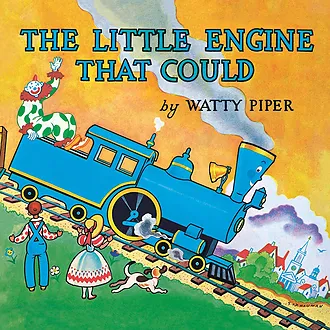
Since this is my last Economic Situation report, I will seize the opportunity to conclude with a review of my all-time favorite book, Watty Piper’s The Little Engine That Could (Platt & Munk, 1930). The book is a can-do story about optimism and the power of positive thinking. I note that the Little Engine is female. But The Little Engine That Could is more than just a children’s book. It is a centerpiece example of what David McClelland and his colleagues discovered in the decades’ long, cross-country research on what explains differences in human achievement.
Using electricity produced per capita as a measure of economic activity and growth, McClelland and his team studied achievement motivation across 40 countries for their primary midcentury global sample, along with a smaller sample of 21 countries. In their search, the things that they thought might predict high achievement—natural resources or investment in education—did not separate high-achieving countries from low-achieving ones. But they found one thing that did the job. It was the frequency of the theme of achievement in the stories read by mothers and fathers to their children: “I think I can!”
A number of years ago, Clemson faculty members were asked to provide their favorite book for a display being erected in the library lobby. My favorite book, The Little Engine That Could, stood high in the stack. Recognizing the transformative powers of words and reading, I note that the late Dolly Parton’s Imagination Library, which sends monthly free books to enrolled children who have an adult to read to them, has sent out 270 million free books since the program started 20 years ago. Watty Piper’s Little Engine is the first book to go to a newly enrolled child.
Yes, I think I can!
Bruce Yandle can be reached at [email protected].
Notes
[1]This section is based on Bruce Yandle, “Will AI Bludgeon Job Markets or Just Some of the Numbers,” DC Journal, May 27, 2026.