- | Housing Housing
- | Policy Briefs Policy Briefs
- |
How to Streamline Housing Permitting in New Mexico
Faster approvals, clearer rules, and practical state and local reforms can help get more homes built in New Mexico
New Mexico faces a housing shortage. After the 2008 Great Recession, New Mexico’s housing production dropped to roughly 40 percent of prerecession production (see figure 1). The state now has a gap of at least 58,000 homes.1From 2015 to 2025, rents rose 48 percent and home values rose 85 percent. Even as the state’s population growth leveled off, housing demand continued to grow. Beyond the ongoing shortfall in new housing production, the housing shortage is also driven by constrained housing supply near major job centers, shrinking household sizes across the state, and aging housing stock in rural areas. Many of these barriers can be addressed through reforms to land use approval and permitting processes.
By streamlining land use entitlements and permitting processes at both the state and local levels, New Mexico policymakers can remove barriers to housing production and make meaningful progress in addressing the state’s housing shortage. Several local jurisdictions, including Las Cruces, Rio Rancho, Albuquerque, Silver City, and Farmington, have already introduced local housing reforms. At the state level, New Mexico is the only state in the Southwest that has not adopted legislative reforms in recent years.2Thus, New Mexico has an opportunity to modernize and streamline state statutes and local codes to create a more efficient, consistent, and transparent regulatory environment for housing production.
The housing permitting process depends on collaboration between builders and government agencies. To better understand how builders and governments work together throughout the housing approval and permitting process, and how those systems might be improved, in the winter and spring of 2026 we conducted roughly twenty interviews and informal conversations, both in person and virtually, with practitioners from both the private and public sectors, including developers, builders, planners, land use administrators, attorneys, and elected officials. Together, these interviews provide insight into the practical challenges that shape the housing permitting process. Based on those interviews, this policy brief identifies bottlenecks and areas of improvement related to the “how” (the process) of housing permitting rather than the “what” (the underlying zoning regulations).
Our findings revealed a great deal of variability in permitting processes across New Mexico. While many jurisdictions have effective permitting processes, there is also a wide range of red tape in both local codes and state statutes that is delaying housing construction. Many local permitting processes overrepresent public input from a narrow demographic rather than weighing the interests and needs of the community at large. As one interviewee stated, “In some cities the development process can just stall out behind the scenes or there are always more hoops to jump through. In others the staff helps developers jump through those hoops and say, OK, here's what you need to do to get this going.”
Based on our findings, this policy brief recommends a menu of best practices that New Mexico jurisdictions can adopt to streamline local permitting through expanded by-right approvals, simpler review procedures, performance management, and targeted infrastructure support. Additionally, we recommend three state legislative reforms that build local capacity, coordinate statewide housing work, and remove statutory constraints: (1) incentive programs that encourage local governments to adopt best practices for streamlining permitting, (2) the creation of a Division of Housing within a state agency, and (3) reforms to existing state statutes to remove barriers to innovative local permitting best practices.
I. How Housing Permitting Works in New Mexico Jurisdictions
The structure of housing permitting processes in New Mexico’s 138 municipal and county jurisdictions can be placed into three categories:
1. Full-service municipalities and counties. Nineteen full-service jurisdictions exercise authority over all aspects of permitting, including planning review, engineering review, and building permitting. Many full-service jurisdictions tend to be larger, such as Santa Fe, Albuquerque, Las Cruces, Rio Rancho, San Juan County, Bernalillo County, and Dona Ana County, while others are smaller, including Corrales, Chavez County, Clovis, Portales, Farmington, Roswell, Artesia, Hobbs, Gallup, Los Alamos, Taos County, and Taos Ski Valley.
2. Hybrid municipalities and counties. This category includes the majority of New Mexico jurisdictions. Hybrid jurisdictions conduct planning and engineering review, while the state Construction Industries Division (CID) in the New Mexico Regulation and Licensing Department conducts building permit review and inspections. Examples of these jurisdictions include Sandoval County, Valencia County, Town of Bernalillo, Los Ranchos, Carlsbad, Ruidoso, Eddy County, Lea County, Mesilla, Silver City, Grants, Aztec, Santa Fe County, Town of Taos, and Espanola.
3. Joint Powers jurisdictions. These jurisdictions are generally small towns and villages where the state CID or regional or county governments conduct all reviews. A Joint Powers Agreement may allow for planning and engineering review through a county or regional Council of Governments (for example, the Enchanted Circle Council of Governments). Discretionary decisions still typically go for approval before the Planning Commission or elected board of the jurisdiction.
The organizational structure of a jurisdiction's permitting process influences how development moves from application to approval, but structure alone does not determine outcomes. Across New Mexico, interviewees described recurring procedural obstacles that delay housing regardless of which permitting model is used.
II. Common Housing Permitting Challenges in New Mexico
This section identifies common challenges with housing permitting, both statewide and within regions, that emerged from the interviews. The discussion begins with a statewide challenge and then examines regional patterns. Housing approvals generally fall into two categories: administrative, or by-right, approvals, in which staff approve projects that meet adopted standards, and discretionary approvals, which require public hearings and case-by-case decisions.
Statewide challenges: “by-right” administrative approval vs. discretionary approval. In housing and land use policy, local governments seek to hear the public’s voice. Housing policy has become unique, however, in that it takes public input at the individual project level (discretionary quasi-judicial decisions), rather than at the policy level (legislative decisions). When zoning policy is established through legislative decisions, projects that comply with those rules can generally be approved administratively. Instead, many jurisdictions rely on discretionary processes involving public hearings, formal findings, and quasi-judicial procedures, which are best reserved for unusual circumstances. Such discretionary processes can block housing by favoring a small number of people who are unrepresentative of the wider community yet are most able to attend public hearings. This often leads to inconsistent interpretations of the zoning code. As one interviewee stated, “Even if you have accomplished zoning reform, it doesn’t mean much if a permitted use is not a permissive use because you have created so many trip wires that allow a few folks to go beyond the written standards.”
To reduce reliance on discretionary approval, in recent years several New Mexico jurisdictions, including Alburquerque, Farmington, and Las Cruces, have adopted or expanded by-right administrative approval processes for housing. These approvals allow individual projects to be approved by staff in accordance with housing regulations adopted by elected officials through land use ordinances. Limitations on this practice, however, exist in state statute, which mandates that jurisdictions hold discretionary public hearings for a subdivision of more than two lots.3These limitations create delays for attainable housing types that typically involve subdivisions, such as starter homes and townhomes. As one interviewee stated, “It’s hard to build housing when you have to do all the work upfront based on what is in the codes, and then go to a hearing where you can be denied for very little reason.”
Regional themes. The following discussion highlights broad themes that emerged from interviews and research. Each regional overview describes the local housing context, the permitting challenges interviewees identified, and the effects those challenges have on housing production. Although not comprehensive, the examples illustrate how housing permitting challenges differ across New Mexico.
In the tourism and laboratory economy of northern New Mexico, there is significant demand for new housing. Many jobs-rich jurisdictions in this region, however, have difficult and time-consuming permitting processes. In addition to the lack of basic by-right administrative approval, delays commonly result from rigid requirements for both preliminary and final plat reviews that subdivide land into multiple lots , rezonings and variances that require approval by multiple bodies, new requirements added after project approval, restrictions on simultaneous review of site plans and building permits, and strict grandfathering-in rules for infill development such as nonconformities or legal lots of record—regulations that can block development on lots that were created under earlier regulations but have difficulty meeting today’s regulations without being grandfathered in. Based on interviews, these permitting practices hinder the creation of new housing for working families near jobs, push people into more affordable but more distant communities, and lead to long commutes and increased transportation costs.
In addition to limiting housing production, lengthy and unpredictable permitting processes escalate development costs and thus contribute significantly to rising housing prices and deepening housing shortfalls. As one interviewee stated, “Truly, time is money in the world of land development. Because you’re spending money and you don't get money back until the project is done. Some local governments just don’t think of it as it relates to finances, and that is why we have this housing shortage.”
In the Albuquerque and Las Cruces metropolitan areas, which include several other municipal and county jurisdictions such as Rio Rancho, Los Lunas, Bernalillo County, and Dona Ana County, some jurisdictions have instituted effective permitting processes, zoning reforms, and a pro-housing culture. Other jurisdictions, however, have administrative approval limits, ineffective appeal process rules, and burdensome notification requirements that can favor a small number of opponents unrepresentative of the community’s needs. Interviewees identified jurisdictions that work effectively with the housing industry to solve process problems but noted that delays can be caused by inflexible platting and subdivision procedures, or uncoordinated internal staff reviews.
In rural areas of New Mexico, some jurisdictions have implemented housing initiatives that proactively create new housing through simplified and streamlined processes. For example, Artesia has created housing incentive programs to partner with developers on infrastructure and other cost drivers that allow housing projects to “pencil,” that is, to become financially feasible (see case study 6, Artesia).
On the other hand, many small jurisdictions in rural areas face the challenge of highly complex codes and a lack of professional staff to manage them. As one interviewee stated, “Many jurisdictions do not have the capacity to understand land use and legal requirements. There's a lot of these instances where there isn't a lawyer on staff, or they have a lawyer that doesn't know land use or is really busy. And they have bought a zoning code that is highly complex, but they don’t know how to use it.”
Interviewees also highlighted the ambitious reforms that jurisdictions have accomplished, as seen in the case studies included throughout this report. The following section draws on those examples to identify best practices for jurisdictions across New Mexico.
III. Best Practices for Housing Permitting
Based on the challenges identified above, this section presents recommendations for New Mexico jurisdictions to modernize housing permitting processes. Many recommended reforms are most applicable to jurisdictions that have the highest housing demand, while smaller jurisdictions with lower housing demand may adopt only the reforms most applicable to their unique housing challenges
1. Elevate public input to the policy level through robust and regular updates to Comprehensive Plans and land development codes. Many New Mexico jurisdictions have already made this shift to a focus on quality and broad-based public input at the policy level (see case study 1, Las Cruces). They are then able to implement by-right zoning at the individual case level because various policy tradeoffs have already been vigorously discussed.
ILLUSTRATES COMPREHENSIVE PLANNING AND ZONING REFORM The City of Las Cruces updated its housing policies through a two-step process: the Elevate Las Cruces Comprehensive Plan in 2020 and a major zoning update called Realize Las Cruces in February 2025. Together, these initiatives marked the city's first major development code update to directly combat housing shortages and rising costs. The city restructured its comprehensive plan and zoning laws to expand housing by allowing multiunit dwellings and accessory dwelling units (ADUs) across all neighborhood zoning districts, with a focus on density in the urban core and mixed-use development in commercial zones and along major transit corridors. Las Cruces also reduced minimum lot sizes, setbacks, and parking mandates, and streamlined infrastructure requirements to favor multimodal options. Source: City of Las Cruces, “City Council Approves ‘Realize Las Cruces’ Development Code,” news release, February 19, 2025. |
2. Implement by-right approvals. By-right approvals give both developers and existing neighborhoods more predictability. The following are important elements of by-right approvals:
- Implement administrative approval. Administrative approval means that if a development project is reviewed by staff and meets the jurisdiction’s adopted standards, the project is approved without going to a discretionary approval hearing at the Planning Commission, City Council, or both. This should be the standard for typical projects, with exceptions for large or unique developments (see case study 2, Farmington).
ILLUSTRATES ADMINISTRATIVE APPROVAL OF RESIDENTIAL SITE PLANS. Source: “Animas Action Plan,” Farmington, March 2024, https://www.farmingtonnm.gov/1234/Animas-Action-Plan. |
- Implement objective standards. A jurisdiction’s zoning code should include objective standards (such as “maximum four stories” or “traffic study required for over 100,000 square feet of development”) rather than subjective ones (such as “follows neighborhood character”), so that a typical person can understand whether a project meets the standards. In the absence of objective standards, professional staff lack a rational basis for approving a project without an appointed commission or elected body weighing in through a discretionary hearing process.
- Reform appeals processes. Employ a development hearings officer to hear appeals of land use decisions made by staff or the planning commission and define who has standing to appeal. Several New Mexico jurisdictions, such as Albuquerque and Santa Fe County, have retained a neutral land use attorney on a consultant basis to serve in this role. The officer provides a neutral expert to resolve complex legal issues, freeing elected officials to focus on broader policy matters. Note that in addition to appeals processes, the officer may also oversee other approval processes, such as subdivisions. This further reduces the need for time-consuming scheduling before elected or appointed boards. Another best practice related to appeals is to raise the threshold for standing. Similar to reforms adopted by the City of Albuquerque, jurisdictions should require that a majority of neighbors in the vicinity of a project must sign on to an appeal (see case study 3, Albuquerque).
ILLUSTRATES REFORMS TO THE LAND USE APPEAL PROCESS. Source: “IDO Updates in 2025,” City of Alburquerque, Interactive Integrated Development Ordinance, accessed August 5, 2026, https://abq-zone.com/ido-updates-2025. |
- Reform the neighborhood notification process. Some jurisdictions have neighborhood notification requirements that require developers to hold preapplication meetings with neighbors, neighborhood associations, or both, to take comment on development applications before submittal to the city. This practice can set an expectation that projects will be negotiated even if they meet code, creating misunderstandings and negative sentiment between developers and neighbors. Many communities have found that neighborhood notifications for typical projects should be limited to notices that an application has been submitted, or that an administrative approval has occurred. Other jurisdictions may have adopted administrative approval but feel that, in place of a public hearing, an additional opportunity for neighborhood input is important. For these jurisdictions, the most productive time for written public input is after staff has reviewed a project for compliance with code and before a final decision is made.
- Allow flexibility through deviations to avoid variances for minor changes whenever possible. The purpose of administratively approved deviations is to allow staff to flex standards by a certain percentage, as long as the intent of the code is upheld. This can prevent lengthy delays for variance procedures that must be heard by a discretionary body and have only a minor substantive effect on the final development. For circumstances where a variance is necessary, the variance criteria should encourage flexibility for applicants. As one interviewee stated, “In some cities, variance criteria make it so there's really no possible way to meet what is called for so it's sort of pointless. But if you have a variance process like Rio Rancho, it really takes into consideration individual property situations. It gives you a voice to be able to present your case and say here are the reasons why I think I should be allowed to do X, Y, or Z and here is how I am still meeting the intent of the code.” To implement this best practice, the variance approval criteria should include language such as “the proposed adjustment in standards allows the project to meet the intent of the code.”
3. Conduct regular analysis of, and goal-setting for, permitting processes. Some best practices include the following:
- Track average times for planning approvals and building permit issuance, and set locally determined shot clocks, or target approval timelines. Set internal goals for the number of days for a typical permitting timeline, assuming typical conditions and development team response times. Evidence from other statewide shot clock efforts demonstrates that they can be effective if used for state agency development approvals (such as a state Department of Transportation) or are implemented voluntarily at a local level (see case study 4, State CID). By contrast, mandatory statewide shot clocks imposed on local governments can sometimes fail to speed permits due to loopholes and unintended consequences, while leaving in place the structural barriers that continue to cause permitting delays.4
ILLUSTRATES THE USE OF PERMITTING PERFORMANCE MEASURES. 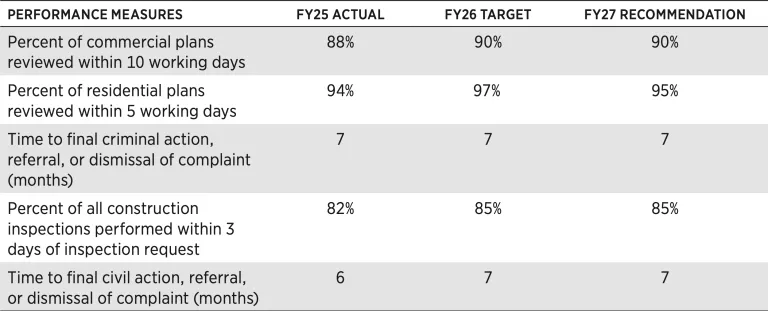
|
- Conduct workflow process mapping to identify bottlenecks. Process mapping is an exercise that clarifies the sequencing of each step in a process.5This exercise can help identify where snags exist that cause permitting delays.
- Conduct surveys of customers and the public. Surveys can help jurisdictions understand and address common user issues in the permitting process.
- Implement annual strategic plans for permitting. Strategic plans should include key performance indicators and metrics that identify permitting bottlenecks, quantitative and qualitative mileposts toward meeting goals, and methods to track departmental efforts towards those goals (see case study 5, Las Cruces–KPIs).
ILLUSTRATES DEPARTMENTAL PERMITTING PERFORMANCE METRICS 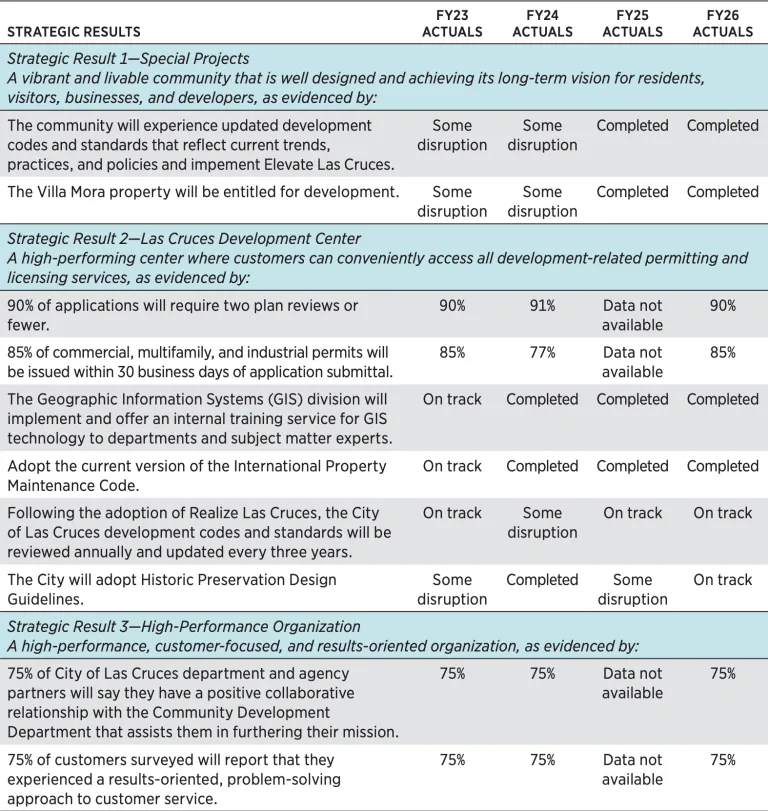
|
4. Simplify development processes in areas where unnecessary complexity causes permitting delays. Best practices for simplification include the following:
- Allow concurrent review of site plan and building permit.
- Allow flexibility to avoid requiring plat amendments for minor changes.
- Allow combined preliminary and final plat approvals.
- Avoid requiring approvals for rezoning or variances from multiple public bodies.
- For post-approval staff punch lists, avoid imposing new requirements or identifying major new issues that were not a part of final entitlements or approvals.
- Within rules for nonconformities or legal lot of record, allow for grandfathering-in of existing conditions in order to assist with infill development, particularly on older properties that have difficulty meeting current code standards that are often written with greenfield development in mind.
5. Elevate the role of government in providing infrastructure to support housing development.
- Support the implementation of spine infrastructure for high-priority housing projects. Local government support for infrastructure may take the form of direct funding, or of waiving impact fees for affordable units. In some cases, it may be appropriate for local governments to lead on the implementation and construction of infrastructure. At the state level, agencies should support local government infrastructure for housing through effective and consistent infrastructure programs targeted at infrastructure needed for housing production (see case study 6, Artesia).
ILLUSTRATES PUBLIC INVESTMENT IN HOUSING INFRASTRUCTURE. The City of Artesia and Eddy County have created innovative partnerships to provide funding for housing, land, and infrastructure to meet regional housing needs and overcome workforce and developer shortages in southeast New Mexico. A development incentive program was created using $500,000 in funding from Artesia and $500,000 from Eddy County. For each new roofline, the city provides a $10,000 builder reimbursement. The City of Artesia also proactively prepares city-owned land for subdivisions to create lots for homes, including for the Armory Heights subdivision and the Legends of Artesia subdivision. The city completes the dirt work and street prep to make the lots ready for homebuilders. The city also has proactively replaced waterlines and made street improvements to service these new residential areas. Additionally, Eddy County granted $6 million to Artesia to buy land for new housing. Collectively, these efforts will relieve the region's housing shortage and spur new growth. Source: City of Artesia (@artesiagov), “Earlier this week city leaders got a look at some of the new housing coming to Artesia. 🤩 We saw the inside of a townhouse before its top half was put on. We also got to watch the crane set the second story in place. 🏗️ ,” Facebook, May 22, 2026, https://www.facebook.com/watch/?v=1631771701412263. |
- Ensure that requirements for development to fund off-site infrastructure are within legal precedents. When determining a development’s requirements for off-site infrastructure improvements (often called exactions, which may include improvements to streets, utilities, parks, and other facilities), jurisdictions must follow the United States Supreme Court’s legal precedents of “rough proportionality” and “rational nexus.”6These legal precedents ensure that the cost of off-site improvements is proportional to the impacts of the development and are not above and beyond that level. Jurisdictions should ensure that their infrastructure standards processes (such as street standards and traffic impact analysis) incorporate these legal parameters in their decision-making.
Streamlining housing permitting requires action at both the local and state levels. The preceding recommendations focus on local permitting practices, while the following recommendations address state legislative changes that can support and expand those efforts.
IV. State Legislative Recommendations
Based on the above data and best practices, we recommend that the state legislature develop the following legislation to improve housing permitting in New Mexico:
1. Provide capacity-building funds for local jurisdictions that voluntarily adopt the permitting best practices in this report. This incentive approach is intended to provide technical assistance funding for local governments while modernizing their entitlements and permitting practices. To access funding, local governments would be required to track permitting metrics and participate in a cohort of other communities in the program. They also would need to adopt items from a menu of best practices. This menu may include adopting expedited permitting processes for housing, reforming zoning codes to facilitate increased housing production, or purchasing permitting software that speeds permitting and tracks permitting metrics.
2. Create a permanent Division of Housing in a state agency. Currently, there is no state agency explicitly charged with carrying out several functions at the intersection of land use and housing issues. This includes tracking data, supporting local governments, and facilitating policy reforms that increase housing production. Many states, including Colorado and Washington,7have state agencies that fill this critical role. While the Mortgage Finance Authority (Housing New Mexico) and the New Mexico Finance Authority play essential financing roles that should continue, New Mexico lacks a central entity to drive a comprehensive housing strategy. The Division of Housing should be authorized to do the following:
- Provide technical assistance to local governments and develop resources such as code templates and preapproved plans.
- Track the number of homes permitted and the housing needs for each jurisdiction.
- Share best practices.
- Coordinate among state agencies that have a role in regulating, financing, or providing infrastructure for housing.
- Administer a recurring funding appropriation for housing grant programs. This should at a minimum include funding for the grant programs (incentivizing best practices) discussed above.
3. Reform existing state zoning and subdivision statutes that restrict local governments’ ability to voluntarily adopt innovative housing permitting practices. These outdated state statutes were primarily written in the 1950s and 1960s but today may inhibit housing production. They require local governments to carry out overly burdensome procedures that add red tape and delays. Similar to reforms in North Carolina, Wisconsin, Montana, and Texas, the New Mexico state legislature should modernize the state’s zoning and subdivision statutes by removing restrictions on local government innovation. This includes language in Section 3-20-8 (subdivision approvals); Section 3-21-6 (zoning hearings and public notice); Section 3-21-5 (zoning conformance with Comprehensive Plan); and Section 3-21-11 (conflicts between zoning and other regulations and ordinances). See the appendix for more details.
V. Conclusion
This report’s recommendations represent concrete steps New Mexico policymakers can take to streamline permitting through local and state efforts. Like the housing crises in many other states, New Mexico’s housing crisis developed over decades. With renewed partnerships between state and local governments, the recent progress many local jurisdictions have made can be replicated across the state, and wider momentum harnessed to make real progress in providing housing for New Mexico’s families.
Appendix
This appendix provides additional details on legislative recommendation number 3, on reforming existing state statutes that inhibit local innovation on housing. All statutory references are to the New Mexico Statutes Annotated 1978.
a. § 3-20-8 on subdivision alternate summary procedures. This section allows local governments to determine their own subdivision approval procedures but limits their ability to use administrative approvals for subdivisions of more than two lots. At the same time, the state allows local governments to approve large industrially zoned subdivisions administratively. Many other states, including Montana, Washington, Texas, and North Carolina, have removed this kind of limitation. Similarly, New Mexico should remove this inhibition on local government by allowing larger administrative subdivisions as a local option.
b. § 3-21-6 on zoning hearings and public notice. This section requires local governments to undertake onerous public notice requirements for rezonings. It also requires a two-thirds city council majority to override an appeal of a rezoning. Many states have concluded that these rules are overly restrictive on local governments and worsen housing shortages. As a result, states like North Carolina, Wisconsin, Montana, and Texas have recently changed their rezoning and appeal statutes so that a city council is no longer legally prevented from exercising its simple-majority voting power under state law. New Mexico should amend this statute to allow local governments to proceed with typical public notice requirements for rezonings and majority rule for rezoning appeals at their own discretion.
c. § 3-21-5 on zoning conformance to comprehensive plan. This section states that local zoning must be in accordance with a comprehensive plan. Zoning must also meet several additional criteria, some of which are consistent with modern best practices such as “secure safety”; “promote health and the general welfare”; and “facilitate adequate provision for transportation, water, sewerage, schools, parks, and other public requirements.” The statute, however, also requires that zoning and comprehensive plans meet several vague criteria that were common in an era before the adoption of modern building safety standards, but that should be removed today. This includes criteria that zoning must “provide adequate light and air,” “avoid undue concentration of population,” “abate the unsightly use of buildings or land,” “give reasonable consideration to the character of the district,” and “conserve the value of buildings and land.” The state legislature should remove these vague criteria that inhibit housing.
d. § 3-21-11 on conflicts between zoning and other regulations and ordinances. This section requires that if any combination of zoning rules conflicts, the more restrictive of the two shall apply in terms of setbacks, height, lot coverage, and other zoning standards. While this may be a reasonable provision in local zoning codes to deal with conflicting provisions, the state should not be mandating this housing-inhibiting practice on local governments. This section should be repealed.
About the Authors
Johanna Gilligan is president of Homewise, a community development financial institution (CDFI) and developer in New Mexico. Her work focuses on housing production, community development, and green lending for low- and moderate-income homeowners. She leads Homewise's advocacy for more connected, walkable, and affordable cities across the state. She was awarded a Loeb Fellowship at Harvard University and a Rockefeller Fellowship at Tulane University.
Veronica Toledo is the senior director of policy and advocacy at Homewise. She has more than a decade of experience advancing public policy and leading community engagement efforts. She earned her BA from Occidental College and an MS in social entrepreneurship from the USC Marshall School of Business. She serves on the Board of Governors at Occidental College and the Board of Directors for Urban Land Institute New Mexico.
Nathan Lindquist is a real estate development and policy manager at Homewise. Previously, he was a policy manager at the Colorado Department of Transportation and developed housing legislation with the governor’s policy team. He has an extensive background in local land use planning, serving as planning director and assistant city manager in Rifle, Colorado.
Salim Furth is a senior research fellow and director of the Urbanity project at the Mercatus Center at George Mason University. His research focuses on housing production and land use regulation. He frequently advises local governments and testifies before state and federal legislatures. He earned his PhD in economics from the University of Rochester.
Notes
[1]Root Policy, New Mexico Housing Strategy: A Call to Action, 2026 Update, 2026. All data and factual statements in this paragraph are based on the Root Policy report.
[2]Mike Easterling, "Lawmakers to Consider Wide Range of Remedies for New Mexico’s Housing Shortage," The Santa Fe New Mexican, January 18, 2026.
[3]New Mexico Statutes Annotated 1978 § 3-20-8.
[4]Salim Furth, Manjula Vaz, and Cameron Artigue, “How to Streamline Housing Permitting in Arizona” (Mercatus Policy Brief, Mercatus Center at George Mason University, November 2025).
[5]“Process Mapping,” Iowa Department of Management (website), last visited July 22, 2026, https://dom.iowa.gov/state-government/lean-enterprise/tools/process-map….
[6]Scott Woodward, “The Remedy for a ‘Nollan/Dolan’ Unconstitutional Conditions Violation,” Vermont Law Review 38 (2014): 701.
[7]Colorado Department of Local Affairs (website), accessed August 5, 2026, https://cdola.colorado.gov/; Washington State Department of Commerce, Housing Division (website), accessed August 5, 2026, https://www.commerce.wa.gov/housing/.

