- | Housing Housing
- | Policy Briefs Policy Briefs
- |
How to Streamline Housing Permitting in New York
Reducing regulatory delays and simplifying approvals can help the Empire State build more housing faster and at lower cost
It is more difficult to build housing in New York than in almost any other state. The legislature recently exempted many housing projects from its onerous environmental review process, but many hurdles remain. Even California builds homes at a faster rate than New York.1 As a result, the Empire State’s population has flatlined, and it risks losing economic dynamism and political power.
The sluggishness and uncertainty of state and local processes for getting housing approved and built are major contributors to the low rate of housing production in New York. Even when a proposed housing development abides by local planning and zoning rules, gaining approval can take years because of New York’s extensive, repetitive permitting process. And time is money: money that New Yorkers pay toward their rent and mortgages.
As figure 1 shows, construction timelines in the northeastern US have risen sharply over the past 25 years. Bringing construction and approval timelines back to reasonable durations would lower the price at which new construction can be brought to market. Doing so requires simplifying processes by eliminating redundancies, depoliticizing the process, and ensuring quick turnaround.
FIGURE 1. Construction duration keeps rising
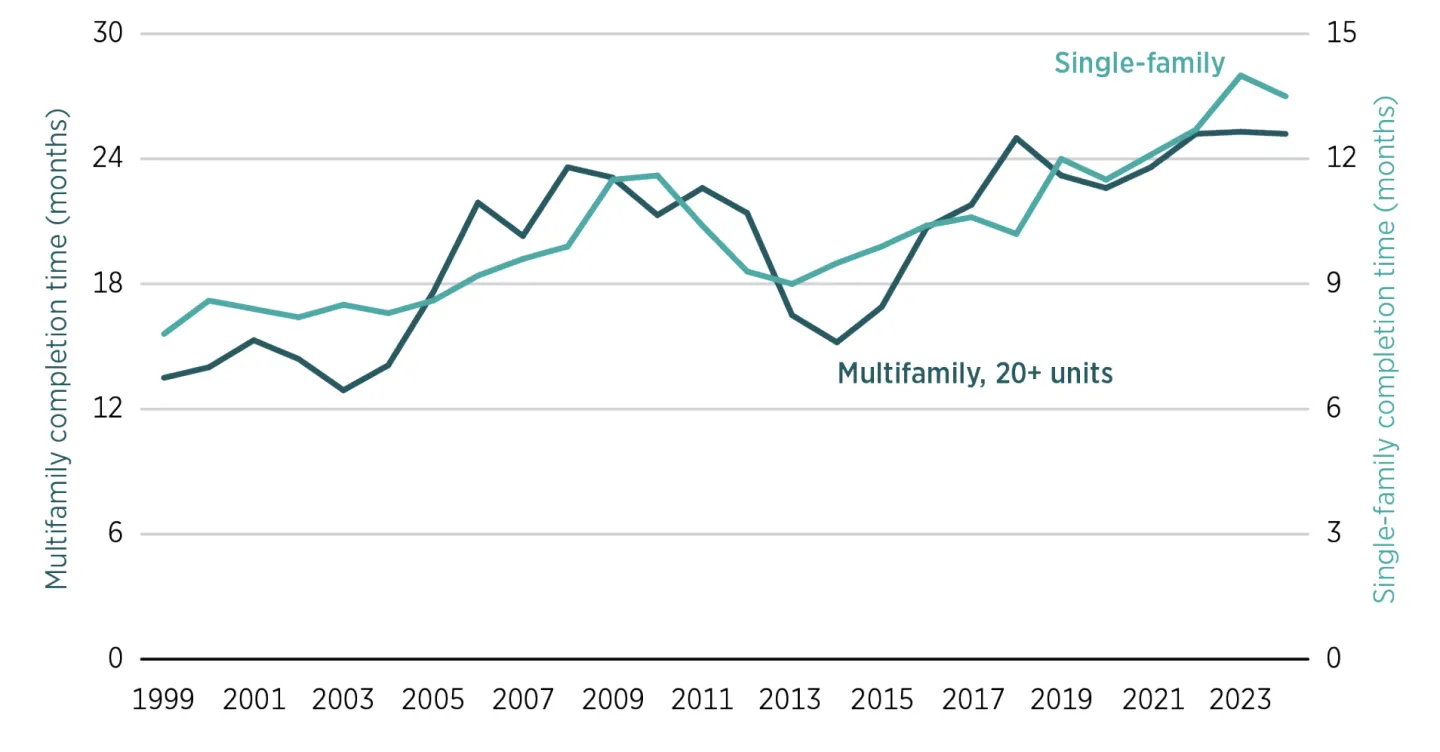
Source: US Census Bureau and US Department of Housing and Urban Development, “Survey of Construction,” 1999–2024.
Note: These data show the time from building permit to completion for homes in the northeast region of the US. The development process before issuance of a building permit is often much longer, but it is not systematically measured.
Research Approach
To undertake the research presented in this brief, we interviewed 24 people who each offered a unique, expert perspective on approval processes. The interviewees work in large and small communities across the state. Most of them directly participate in permitting, as either applicants or officials. The interviewees included the following:
- Eleven in the private sector, nine in the public sector, two with both public and private roles, and two in research2
- Nine planners, five developers, three attorneys, two code enforcement officers, and five others
- Representation from across the state, with the largest concentrations in Westchester County, Rochester, and the capital region
Our research did not cover New York City, which has a unique land use approval process that others have capably reviewed.3
How New York Permitting Works Now
Although approvals for housing in New York wind through different pathways that combine reviews with distinct legal definitions, such as subdivision review, site plan review, and variances, the interviewees drew relatively little distinction among these procedures. Regardless of the legal formalities, every approval pathway covers most of the same ground and allows almost unlimited discretion to the municipality.
A municipality can use New York’s procedural requirements to grind an undesired project to a halt. But the procedures are not so flexible that it can whisk a welcome application through in a few months. In fact, several interviewees described ways that localities bend over backward to enable new housing construction, including by giving tax breaks. Downstate multifamily developers often rely on payment in lieu of taxes (PILOT) agreements along with other state and federal tax credits or grants.4It takes years to line up all the potential funding sources, which must typically be done before beginning the local approval process. If approvals were quicker and more certain, PILOTs would not be needed as often, and municipalities would raise more revenue from new construction.
Paths to approval
The most common and important forms of review or approval include the following:
- Rezoning. Zoning determines whether housing can be built in a location and at what density. Single-family housing in New York is usually built in the places where the local authority—city, town, or village—has affirmatively zoned for it. Multifamily housing more often requires rezoning from a lower-density or nonresidential zoning district. A rezoning must be approved by the local government’s legislative body, such as the city council, typically after an advisory review by the planning board.
- Subdivision review. To divide land into house lots, a developer must obtain approval from the municipality’s planning board.5The planning board can consider a wide range of potential issues, from emergency access to aesthetics. It must abide by federal stormwater requirements, which include sending a completed approval to the state Department of Environmental Conservation for reapproval and acknowledgment.6
- Site plan review. Legally, site plan review can cover most of the same topics as subdivision review. In practice, towns sometimes combine subdivision and site plan into a single review.
- Site plan review allows municipalities to subject multifamily proposals to discretionary review even when objective criteria, such as zoning compliance, are met.
- Some municipalities offer minor subdivision review or minor site plan review for smaller projects. In most cases, however, there are no objective criteria, and the reviews must still be approved by the planning board. In some states, such as Washington and Texas, site plan review is usually administrative and is carried out by professional staff following standard rules.7
- Variances. A variance cannot approve a project, but it can allow a project an exemption from a particular requirement. Most new housing in New York requires at least one variance, reflecting the fact that the rules are written too tightly to allow viable construction to occur. Unlike the previous approvals, variances are handled by a locality’s zoning board of appeals.
- Advisory reviews. Depending on the municipality and the application, an application may require advisory review by a planning board, an architectural board, a historical board, or a local conservation board.
- County review. Projects near a town boundary, fronting a state- or county-owned road, or adjacent to county-owned land must undergo an additional review by the county. This review is not dispositive—the municipality can override a negative county review with a supermajority vote—but it can add months to the process.8
For each review that an application undergoes, with a few exceptions, the government body must hold a public hearing. Members of the public are invited to raise their objections to the project. Naturally, the public does not limit its comments to issues that are germane to the specific review being undertaken (and sometimes the public asks its representatives to illegally discriminate9), which contributes to the blurring between types of reviews.
The plethora of boards can create inconsistencies between approvals. A common problem the interviewees noted was that, because the overall review process was so long, they frequently ran into changing politics. In one case, a new mayor slow-walked a multifamily development because it was associated with the previous mayor.
State Environmental Quality Review
All these paths to approval trigger New York’s unique State Environmental Quality Review (SEQR), which is required for any discretionary local government land use decision. Unlike specific environmental protection laws, SEQR does not uphold any particular environmental standard. Rather, it is intended to ensure that no major environmental impacts of a decision have been ignored. And the law creates many opportunities for procedural litigation. As a result, developers and local governments undertake extensive preemptive work to avoid being sued. In this section, we provide a nontechnical sketch of the SEQR process.
The SEQR process commences early in the application process: A municipality cannot grant subdivision, variance, special permit, or site plan approval without completing the SEQR requirements. The first step is to classify the project as nondiscretionary, Type II, Unlisted, or Type I.
Nondiscretionary actions are exempt from SEQR. Some minor discretionary actions, such as permits to construct a single house, have long been classified as Type II and exempted from review beyond the classification step.
After our research was completed, New York’s legislature greatly expanded Type II exemptions for housing.10Now, construction of up to 100 dwellings on previously disturbed land, or up to 300 dwellings in an urban area, is a Type II action.11This is a radical and welcome change. Our research covered the period before the law. The processes described in this section now apply to a much narrower segment of the new housing market.
If a discretionary action is not specifically listed as Type II, it must instead be Type I or Unlisted and thus requires SEQR. These actions range from adopting a comprehensive plan, to areawide rezonings, to constructing a fourplex.12
Coordinated review is required for Type I actions to establish which of the involved agencies (such as the city council or planning board) will take the lead. Controversies are rare, but the prospective lead agency must nonetheless wait 30 days in case any other body wishes to contest leadership.
The applicant, the lead agency, and often consultants for both sides must fill out an environmental assessment form (EAF) to guide the agency’s determination of significance. An action is significant if it is “reasonably expected” to have negative effects, including some that have little or nothing to do with the environment, such as the following:
- (v) the impairment of the character or quality of important historical, archeological, architectural, or aesthetic resources or of existing community or neighborhood character; 13
- (ix) the encouraging or attracting of a large number of people to a place or places for more than a few days, compared to the number of people who would come to such place absent the action;14
Most criteria include vague language such as “substantial” or “major.” None of the SEQR criteria directly consider climate change. Criterion (ix), quoted above, basically says that people are pollution. The criteria are out of step with contemporary environmentalists who prioritize addressing climate change and favor compact, energy-efficient cities.
Interviewees estimated that the EAF for an apartment complex takes 4 to 12 months to complete, because consultants recommend attaching to the EAF studies of how many schoolchildren the project would generate and its effects on traffic and parking. This “expanded EAF” is not required by state law. But it can reduce confrontation with the public, and it serves as a partial defense against litigation.
If the lead agency determines that the action will have a significant adverse impact on the environment, it issues a Positive Declaration. Otherwise it issues a Negative Declaration. The interviewees indicated that, when in doubt, agencies are most likely to determine that an action is significant. This cautious approach reduces the risk of a lawsuit at the cost of spending an extra year in the approval process.
A Negative Declaration usually ends the SEQR process and allows the local government to proceed with the regular permitting process. Or the government might be sued. Professor Michael Gerrard counted 43 SEQR lawsuits in 2024, including one in which the City of Troy was forced to reverse its Negative Declaration on behalf of a rezoning for 240 apartments.15The lawsuit delayed all proceedings for 27 months and has likely killed the project.16Lawsuits and appeals also held up construction of an assisted living facility in Huntington for six years without finding any substantive environmental issue.17
Following a Positive Declaration, the lead agency formally determines the scope of the environmental impact statement (EIS). Scoping identifies which issues the EIS must address and should “eliminate consideration of those impacts that are irrelevant or non-significant.”18The latter is harder than it sounds: Municipalities tend to expand scoping to negligible or irrelevant issues, partly to preempt public complaints. And because SEQR defines “environment” so broadly, it is difficult to narrow the scope.
The mandatory public review process for scoping also contributes to SEQR mission creep. Any member of the public can raise an issue, such as parking, which then must be analyzed.
Once the scope is finalized, the applicant’s consultant performs more studies and prepares a draft EIS that analyzes potential environmental impacts, alternatives, and mitigation measures. The lead agency reviews the draft and decides whether it is adequate for public review. When accepted, the draft EIS is circulated for comment and a public hearing.
When the draft EIS is approved, often after multiple drafts, the consultants prepare a final EIS that responds to public comments. The lead agency reviews the final document and then adopts formal findings. These findings explain how environmental considerations were incorporated into the decision-making process and whether mitigation measures or alternatives will be required.
Only after the findings statement is adopted may the agency make a final decision on the underlying action (a rezoning or site plan approval, for instance). Or, again, the government might get sued. The Town of Greece was recently sued for proceeding with steps to allow senior housing at the edge of a neighborhood.19One allegation is that the completed EIS is too old and needs to be done all over again.
In all, about one in 20 housing units completed in New York has to overcome a lawsuit along the way.20That’s a shockingly high rate and only hints at the number of building projects forgone because of the high risk of litigation.
Inspections
After all reviews are completed, the local government issues a building permit, and the actual business of construction can begin. At each stage of construction, and for each of a building’s systems (electrical, plumbing, etc.), the developer must pass an inspection to ensure compliance with both the building code and the approved plans. Building permits are typically granted for one year and sometimes expire before construction is complete, requiring a permit renewal.
The interviewees agreed that inspectors are largely capable and clear. They noted, however, that the relationship between government-employed inspectors and contractors sometimes leads to problems:
- Smaller local governments often outsource inspections entirely to firms that have a financial incentive to string out the inspection process as long as possible.
- For more complex projects, such as high-rises, local governments rely on special inspectors. The generalist local inspector, however, typically schedules a second inspection of systems already cleared by the specialists.
In addition, inspectors sometimes demand changes that conflict with the plans as reviewed and approved. This can happen when the inspector interprets best practice differently than the plan reviewer.
Changing rules
Even though our interviews were focused on the regulatory process, many of the interviewees emphasized that New York’s state regulatory stance has become increasingly hostile to new housing. The legislature has banned new gas line hookups, a reckless risk in a climate where winter storms regularly knock out electric power to thousands of homes. That law is not being enforced while it undergoes a court challenge.21
A court also annulled new environmental rules because the administration failed to perform a sufficient SEQR.22Those rules expanded the definition of wetlands and restricted construction within 100 feet of all wetlands in urban and suburban areas, including on sites that have been previously developed. The rules would have made it much harder to build housing, but their annulment leaves an uncertain legal environment until the state repeats the rulemaking process.
On the opposite side of the ledger, the 2026 reforms to the SEQR process have the potential to limit the most onerous procedural barrier to housing. Although data are not available, we expect that the exemptions for residential construction on previously disturbed land will free most new multifamily housing from SEQR. New subdivisions, however, more often replace agriculture or undisturbed land and will rarely be exempt.
Recommendations
- Narrow the focus of planning and zoning boards
- Create administrative minor subdivisions and site plan reviews
- Allow administrative modifications (minor variances)
- Encourage municipalities to merge zoning and planning boards
- Reduce delays from higher government reviews
- Empower a development ombudsperson within the Department of Transportation
- Eliminate NYSDOT review for some applications
- Require prompt turnaround of NYSDOT review
- Narrow and speed up county review
- Eliminate the statute-of-limitations loophole in county review
- Keep wetlands determinations stable
- Refocus SEQR on core environmental priorities
- Reduce delays in identifying the lead agency
- Expand SEQR exemptions
- Limit baseless lawsuits
- Limit scope creep in environmental impact statements
- Remove topics from SEQR that do not pertain to water, air, and land
- Smooth the inspection process
- Extend the duration of building permits
- Allow applicants to hire third-party inspectors
- Eliminate redundant inspections
- Require inspections to abide by approved plans
Narrow the focus of planning and zoning boards
Relative to other states, it is striking how much work is required of New York’s volunteer planning and zoning boards; one or the other approves almost every step in the entitlement process. Requiring their approval for small, technical matters does no favors to the applicants or the board members, and it may delay the boards’ consideration of more substantive projects.
Create administrative minor subdivisions and site plan reviews
Many states allow small-scale subdivisions and site plans to be reviewed administratively. That is, municipal staff, rather than the boards, review them for compliance and make a determination. The planning board can intervene to take up a matter it deems important, and applicants can appeal if they feel wrongly denied. The state could, for example, require that site plans and subdivisions of less than four acres that do not create new streets be reviewed administratively.23
Allow administrative modifications (minor variances)
Interviewees found that most projects needed small variances for approval. To expedite the least consequential variances, the state could create a new category. In Rhode Island, such variances are called “modifications,” and their extent is clearly limited in statute.24A municipal staffer may grant a modification administratively if no objection is received from neighbors after notice.
Encourage municipalities to merge zoning and planning boards
New York law already allows municipalities to have a joint planning–zoning board, an option taken by some small villages and towns to economize on volunteer time. Another reason to merge zoning and planning boards, even for larger jurisdictions, is to allow the municipality to have a more unified voice regarding land use policy and to reduce the redundant public hearings on projects that need both site plan review and variances, for example.
Reduce delays from higher government reviews
New York’s permitting processes frequently involve three levels of government. Short of entirely eliminating county review, although that would bring New York in line with regional norms, we suggest several ways to reduce the number of projects going before county and state bodies.
Empower a development ombudsperson within the Department of Transportation
Although it was not a universal opinion, some interviewees said that the worst state agency to ask for approval was the New York State Department of Transportation (NYSDOT). Any project that fronts a state road must receive the agency’s approval to ensure that development does not conflict with state road planning or drainage. Precisely because the approval check is unrelated to the agency’s core mission, it is a low priority at NYSDOT. The governor can improve performance rapidly by empowering an ombudsperson or manager within NYSDOT to ensure that the simplest applications are returned as approved within two business days.
Eliminate NYSDOT review for some applications
In one case, an interviewee told us about an office-to-residential conversion on a state highway. The project did not alter the existing driveway or site layout, and it reduced peak-hour traffic. But it waited more than a year for approval. By regulation, the governor should exempt from NYSDOT review most projects that do not involve work within the state highway right-of-way.25New regulations should spell out objective thresholds, such as the increase in the number of onsite parking spaces, above which review is required.
Require prompt turnaround of NYSDOT review
To ensure that NYSDOT does not drift back into slow approvals in the future, the legislature should create a shot clock for review. For example, if NYSDOT does not respond to the application within one week or approve or deny it within six weeks, it is deemed approved.
Narrow and speed up county review
The interviewees agreed that county review takes time while rarely altering projects. We suggest reducing the number of instances in which county review occurs. Most obviously, variances, special permits, and small projects should be exempted (perhaps those that disturb less than four acres of land). And the circumstances under which county review occurs should be reduced: Counties need not review every project within 500 feet of a state-owned road or park, for example. For larger projects, one possibility would be to give county planning departments seven days to decide if they want to perform a full review of an eligible project, otherwise allowing it to proceed. In addition, the legislature should impose a prompt deadline for county review.
Eliminate the statute-of-limitations loophole in county review
One interviewee noted that unlike other aspects of the review process, a failure to refer a project for county review can be litigated for up to six years.26That makes construction lenders nervous. The legislature should reduce this source of uncertainty by cutting the statute of limitations to a few months—enough time for an aggrieved county to demand its say, but not so much that legal uncertainty can extend into the construction process.
Keep wetlands determinations stable
Determinations of the extent of wetlands can change a bit each time a site is studied. That fickleness is in tension with the regulatory role of wetlands determinations, which is to fix the boundary between developed and undeveloped land for decades. To reduce the uncertainty around wetlands determinations, a landowner should be allowed to rely on a determination for a significant amount of time, perhaps 15 years. This would allow a single wetland determination to be undertaken for a large site (for example, an area planned for revitalization) and then relied on by individual investors.
Refocus SEQR on core environmental priorities
SEQR’s lack of boundaries has made it a greater barrier to housing development than the few comparable state environmental review acts. (Most states have no such acts.) The most important step that New York lawmakers can take to rationalize the development review process is to focus SEQR on the core priority of protecting the natural environment. We suggest several ways to accomplish that goal.
Reduce delays in identifying the lead agency
The state requires a 30-day waiting period to establish the lead agency in combined SEQR proceedings. It should adjust this requirement by allowing the period to lapse after seven days if no other agency has expressed interest. That adjustment would allow sufficient time for negotiations in the rare cases in which multiple agencies wish to lead without adding several weeks of pointless delay to the majority of cases. The state should also allow and encourage municipalities to set the default lead agency by ordinance.
Expand SEQR exemptions
The 2026 reforms enacted large, important exemptions to SEQR. The legislature could go farther, however, for cases in which the new exemptions do not qualify. We suggest the following:
- Variances. These must, by law, be minor adjustments and should be Type II.
- Special permits. These are, by ordinance, uses with attached conditions that the planning process has found broadly appropriate where zoned and should be Type II.
- Rezoning, subdivision, site plan, and other reviews for residential development on commercially zoned sites, including those with undisturbed land. These sites are already approved for intense use. Thus, these can be Type II actions.
And the state should eliminate redundant reviews by adding exemptions for the following:
- Projects that are consistent with a comprehensive plan adoption or update that underwent SEQR in the past 15 years. Some projects are already covered by plan-level SEQR. But it should be clearer that a benefit of adopting a comprehensive plan is to consider its environmental impacts broadly rather than seriatim.
- Projects that are subject to National Environmental Policy Act review, which is similar to SEQR. These projects can be exempt from the state-level review to avoid redundancy.
Limit baseless lawsuits
The legal system provides essential protection for everyone in society. But it is also abused by those who file baseless lawsuits that are intended to extract concessions and waste time despite having no chance of winning a final verdict. This abuse hurts everyone whose access to justice is delayed. New York’s SEQR has become a font of tactical lawsuits.
We suggest limiting such lawsuits by requiring that any lawsuit challenging a SEQR or land use decision be accompanied by an allegation of particularized individual harm that is actual or imminent. That allegation must be backed with a professional opinion from a relevant expert. For example, a neighbor could sue alleging risk to his health if an environmental engineer reported that development was likely to release hazardous soil contaminants in ways unacknowledged by the EIS. But a court would dismiss a lawsuit alleging that the EIS failed to consider soil contamination if it were unaccompanied by expert opinion finding that soil contamination is likely and would directly harm the plaintiff.
Limit scope creep in environmental impact statements
When a lead agency determines that an EIS is needed to comply with SEQR, it defines the scope of that EIS. The interviewees found, however, that EIS preparation often ranged far beyond that scope, partly because statute allows anyone to expand the scope by providing a mere “written statement.”27SEQR is already a second-look statute; it does not need a third-look provision. The legislature should revise to block scope changes.
Remove topics from SEQR that do not pertain to water, air, and land
SEQR takes a maximalist view of what is “the environment,” including subjective local political and aesthetic considerations. Our view is that these social and political concerns are already well represented in the political system, which is, after all, representative of human residents. The purpose of having a secondary environmental review backstopping local government is that the government may undervalue aspects of the nonhuman environment that are not fully felt by local residents.
SEQR’s requirement to consider the “character or quality of the existing community” is also an invitation to quietly engage in class and racial discrimination.28Scholars of land use decisions have found that, far from being an undervalued aspect of local decisions, existing character is a core motivation and is effectively centered by those who choose to participate.29
The legislature should refocus SEQR on core priorities by removing topic areas that do not pertain to water, air, and land.
Smooth the inspection process
Inspection processes are more professional and predictable than entitlement and environmental review. But ironing out some wrinkles would reduce costs and keep construction moving.
Extend the duration of building permits
One interviewee noted that for large projects, building permits typically expire before construction is complete, requiring a renewal. The state should require that building permit durations be set to ensure that renewals are rarely needed—perhaps two years for smaller projects and four years for larger ones.
Allow applicants to hire third-party inspectors
Third-party inspectors are already heavily used. But in most cases, they are hired by the municipality and bill by the hour, not by the job, and thus have an incentive to stretch out their work. New York should follow several other states in allowing developers to hire qualified and approved third-party inspectors at their own cost.30
Eliminate redundant inspections
The legislature should ban requirements for redundant inspections. The interviewees indicated that these occur when a third-party specialist inspects a system and then the municipality undertakes its own follow-up inspection of the same aspect of construction at the same phase, thereby imposing a delay.
Require inspections to abide by approved plans
Inspectors sometimes demand changes to construction from what was approved in written plans. Such inconsistencies usually occur because of differences in interpretation between the plan reviewer and the inspector. To discourage this inconsistency, the legislature should require that the jurisdiction bear some financial burden, such as refunding the building permit application fee, if an inspector fails to approve an aspect of construction that was explicitly approved in plans.
Conclusion
Demand for housing is strong in many parts of New York. But supply is unable to meet demand at a reasonable cost because of restrictive land use regulations and onerous approval processes. In recent research on a similar jurisdiction, professors at Princeton University and the Massachusetts Institute of Technology found that slow and uncertain permitting costs $4.70 per square foot of land, or about $200,000 per acre.31The legislature and governor should work together to enact and enforce reforms that will allow permitted housing to be built more quickly and at lower cost.
About the Authors
Silvia Del Fava, AICP, LEED AP ND, is a senior associate at BFJ Planning. She supports municipalities and state agencies across New York on planning, zoning, and environmental review projects. Before joining BFJ, Del Fava was a fellow at Pratt Center for Community Development and worked for New York City agencies, a planning firm, and an architecture practice. She holds a BA in urban studies and planning and geography from the University at Albany and an MS in sustainable environmental systems from Pratt Institute.
Salim Furth is a senior research fellow and director of the Urbanity Project at the Mercatus Center at George Mason University. His research focuses on housing production and land use regulation. He frequently advises local governments and testifies before state and federal legislatures. He earned his PhD in economics from the University of Rochester.
Notes
[1]New York’s housing stock increased by 3.2 percent from 2020 to 2025. In the same period, California’s increased by 4.2 percent. US Census Bureau, “Housing Unit Change Viewer: 2020 to 2025,” accessed May 28, 2026, https://mtgis-portal.geo.census.gov/arcgis/apps/experiencebuilder/experience/?id=3a87e24a2ec54e01ab277a12d467e7d9.
[2]The private-sector interviewees include people in nonprofit organizations that represent primarily industry interests. We requested interviews from at least 30 others.
[3]Citizens Budget Commission, “Improving New York City’s Land Use Decision-Making Process,” September 6, 2022, https://cbcny.org/research/improving-new-york-citys-land-use-decision-making-process.
[4]A PILOT is effectively a negotiated reduction in future local property taxes.
[5]In some places, subdivisions are approved by the elected municipal board rather than the planning board.
[6]See New York Department of State, Subdivision Review in New York State, November 2024, https://dos.ny.gov/system/files/documents/2024/11/subdivision-review-in-nys.pdf.
[7]Municipal Research and Services Center, “Planning and Development Permit Review,” last modified December 30, 2025, https://mrsc.org/explore-topics/planning/administration/permit-review; and City of San Antonio, “Plan Review,” accessed May 18, 2026, https://www.sa.gov/Directory/Departments/DSD/Constructing/Residential/Plan-Review.
[8]This process is prescribed by New York General Municipal Law § 239-m and § 239-n, and it includes “planning and zoning actions” ranging from the adoption of a comprehensive plan to the approval of a variance.
[9]Lawyers’ Committee for Civil Rights Under Law, “Federal Court Holds That Garden City, New York Zoning Decision Had Unjustified Disparate Impact on African Americans and Latinos,” press release, September 26, 2017.
[10]S. S9008C, 2025–2026 Leg. Sess. pt. R (N.Y. 2026). The text of the bill is available at https://www.nysenate.gov/legislation/bills/2025/S9008/amendment/C.
[11]Id. To be exempt, the site has to be outside flood zones, nonagricultural, and free of hazardous materials, and the dwellings must connect to existing water and sewerage systems. New York City and localities without zoning are treated separately in the law. The law also puts a one-year time limit on the determination of the need for an environmental impact statement (EIS) and a two-year limit on the preparation of an EIS. It allows extensions in difficult cases, however, so we are unsure whether the time limits will be an important aspect of the reform.
[12]N.Y. Comp. Codes R. & Regs. tit. 6, § 617.4. The updated Type II list exempts fourplexes in many circumstances, but not all.
[13]Id. § 617.7(c).
[14]Id.
[15]Michael B. Gerrard, “The Past and Future of SEQRA: Reflections After the 50th Anniversary Conference,” Columbia Public Law Research Paper No. 6183438 (Columbia Law School, February 5, 2026); Bennett v. Troy City Council, 231 A.D.3d 1386 (3d Dep’t 2024).
[16]We can find no evidence that the application has been resumed.
[17]Matter of Vojta v. Town Bd. of the Town of Huntington, 2025 N.Y. Slip Op. 05525 (App. Div. 3d Dep’t 2025).
[18]N.Y. Comp. Codes R. & Regs. tit. 6, § 617.8.
[19]Kevin Oklobzija, “Greece Board Accused of Ignoring Health Risks in Wetlands Sale,” Rochester Business Journal, November 25, 2025.
[20]Zöe Scott, “Impacts of SEQR Litigation on Residential Development in New York State, 2010–2025,” Environmental Law in New York Newsletter, February 2026, as cited in Gerrard, “Past and Future of SEQRA.”
[21]Niina H. Farah, “Appeals Court Wrestles with NYC and New York State Gas Bans,” E&E News, February 2, 2026.
[22]Adam Stolorow, Ahlia Bethea, and Charlotte Hawes, “NY Court Annuls DEC Freshwater Wetlands Regulations,” Sive, Paget, Riesel Blog, April 17, 2026.
[23]Bills introduced in the 2026 New York legislative session, S. 8642A and A.10678, would enact similar reforms to the subdivision process.
[24]R.I. Gen. Laws § 45-24-46.
[25]N.Y. High. Law § 52 requires work permits within the state highway right-of-way. In addition, 17 N.Y. Comp. Codes R. & Regs § 125 requires work permits for projects that change the use of existing access points.
[26]John C. Armentano, “New York’s General Municipal Law §239-m: ‘An Ounce of Prevention Is Worth a Pound of Cure,’” Long Island Land Use and Zoning (blog), May 3, 2021.
[27]N.Y. Comp. Codes R. & Regs. tit. 6, § 617.8.
[28]Jenna L. Dublin-Boc, “Zoning for Character: Contextual Rezoning and Socioeconomic Change in New York City Neighborhoods, 1986–2019,” Land Use Policy 134 (2023): 106910.
[29]Katherine Levine Einstein, David M. Glick, and Maxwell Palmer, Neighborhood Defenders: Participatory Politics and America’s Housing Crisis (Cambridge University Press, 2019).
[30]Bills introduced in the 2026 New York legislative session, S.7217A and A.7675A, would enable a municipally initiated third-party review program for a select group of downstate jurisdictions.
[31]The authors measured how much the value of land in Los Angeles County, California, grew when it was entitled for ready-to-issue building permits. See Evan Soltas and Jonathan Gruber, “How Costly Is Permitting in Housing Development?” (working paper, Princeton University and Massachusetts Institute of Technology, February 2026), table A20.

