Alexander Kobuss’s Mercatus Fellowship Story
Alexander Kobuss: Rediscovering Mainline Economics in Germany


undefinedundefined
lexander Kobuss came to the Carl Menger Fellowship as a German PhD student studying the history of economic thought, specifically Germany's social market economy. "When I started out as a bachelor student, I was actually studying to become a teacher originally. So, my subjects were politics, economy, sociology, and history. So, I guess you could kind of call it a PPE program but specifically designed for teachers. During my time, when I started out in my studies, I was still mostly focused on, how do I implement this for my teaching career? But as I started to get more into history of economic thought, especially, I saw, okay, the subject matter is actually quite interesting in itself, not just in a teaching context."
The Carl Menger fellowship was a one-year online program for doctoral students from any university and discipline interested in political economy. Students participated in online seminar discussions on the Austrian, Virginia, and Bloomington schools of political economy.
I was really open just to do anything associated with Mercatus [...]
A German scholar suggested he apply to Mercatus "I was really open just to do anything associated with Mercatus because the scholar Stefan Kolev...he said, okay, you have to study with the Americans. It's a different way of studying." The fellowship was online, which made logistics work from Germany.
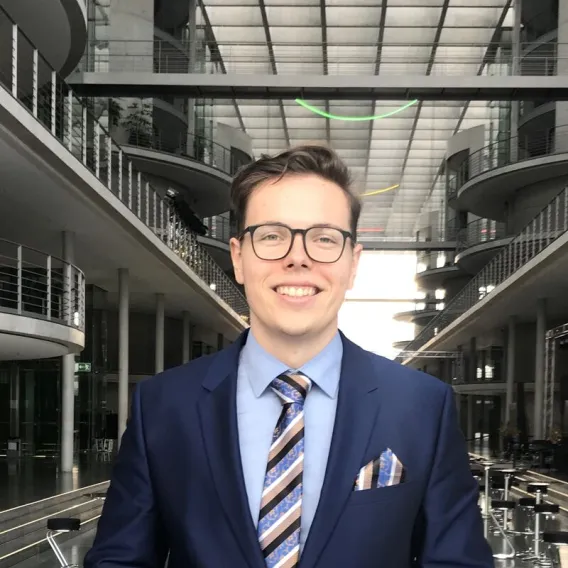
That [mainline economic thought] just totally shifted the way I looked at economic history in general. So, from that point onward, I decided, okay, I'm going to teach this difference to my students.
Alexander had read most of the thinkers the fellowship covered; Adam Smith, Tocqueville, Hayek, Mises, Ostrom. He was familiar with their work, but as he entered the fellowship discussions, he was introduced to a different way of understanding economics history. "When I approached those thinkers back during my studies at my time in my master's degree, I always looked at them, okay, you have mainstream economic thought and you have neoclassical economics and then you have Keynesian economics and then it's just a back and forth and you have some Friedman in there and then modern discourse basically revolves about either you are a neoclassical economist or you are a Neo-Keynesian economist. And when you looked at other schools of thought, like Austrian economics in general, it was seen as heterodox, weird, fringe theory."
"That [mainline economic thought] just totally shifted the way I looked at economic history in general. So, from that point onward, I decided, okay, I'm going to teach this difference to my students. And I'm going to approach economic discourse from a completely different angle because the narrative is so powerful."
He was assigned to a group of aspiring teachers in their second and third semesters, and he taught them the mainline political economy narrative.
[...] I think mainline economic theory is not just a politically and academically powerful narrative, it's also a very useful narrative for reaching students in education.
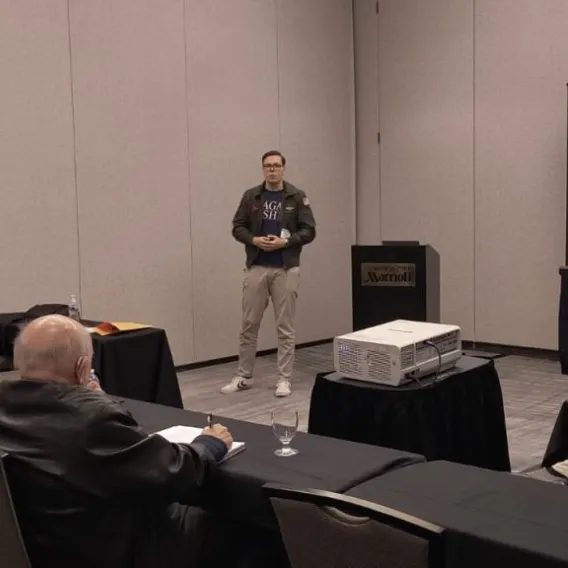
His students' reaction astonished him. Not only did they become engaged, but they also said it was their favorite class. "And not only is the narrative of mainline economic thought politically powerful to reclaim narratives in the field of academia in general, but it also, at least I noticed, created a new interest with my group of students because they said nobody has told us this. We have to do a lecture and our professor tells us something about marginal utility and lets us look at graphs and we have to calculate this or we have to learn about Keynesian interventionism, this and that or deficit spending. And then it's just, learn this, you learn that, but there is no context involved. They don't know the purpose of what they are doing. And I think mainline economic theory is not just a politically and academically powerful narrative, it's also a very useful narrative for reaching students in education."
The fellowship also gave him a window into a different academic culture. Germany's intellectual tradition, he explains, is collectivist in nature. American academic research especially at Mercatus feels different. "German research is much like German humor. It's usually very dry and quite boring. So, the American way of approaching things in a much more, let's say, direct, lighthearted, not so convoluted way, I think that's what really appealed to me in general and what appealed to me about Mercatus as well."
Besides the fellowship, he continues engaging with Mercatus presenting his research at Markets and Society. His first time ever presenting at an American conference. A friend, Benedikt Schmal, had presented the year before and encouraged him to come. Standing among hundreds of scholars discussing everything from Polish liberalism to K-12 education reform, "I'm at the cutting edge of something and at the cutting edge of academic discourse in a very specific setting."
He advises future fellows to engage with the readings and ask questions, "If you just ask the question, 90 % of the time you will get an interesting, nice response that sparks something new. Maybe it's a paper, maybe it's a personal connection. Maybe it's just an interesting inquiry."