Alicia Plemmons's Mercatus Fellowship Story
How Mercatus Fellowships Helped Alicia Plemmons Build Her Career and Network

undefinedundefined
hen Alicia Plemmons discovered the Mercatus Center at a conference table, she was a PhD student at Georgia State University a school outside the classical liberal network where nobody was connected to these free market ideas. "I was one of the more external on the fringes people. The reason why I had found out about Mercatus was just a table that they had at a conference and talking to people. And it seemed like really interesting stuff" she recalls.
Through the Frédéric Bastiat Fellowship and later the James Buchanan Fellowship, Alicia found the intellectual community and theoretical foundations that transformed her understanding of regulatory economics. Today, as an associate professor at West Virginia University running a center and publishing on regulatory policy, Alicia credits those fellowships with building the network and knowledge base that launched her career, so much so that she now sends her own students to Mercatus fellowships every year.
Thinking about that foundational historical theory made me a lot more interested in why I sort of thought regulations in general was my niche.
Before Bastiat, Alicia knew regulations bothered her but didn't understand why. "I was interested in occupational licensing, and I was starting to write on occupational licensing," she explains. The fellowship readings changed everything. "It made me realize I was a regulation economist. Once I learned a little bit more from the theory side, because being from someone who's sort of outside the Mercatus world, theory is not in a lot of grad programs. So thinking about that foundational historical theory made me a lot more interested in why I sort of thought regulations in general was my niche."
The Frédéric Bastiat Fellowship is a one-year program that brings together graduate students from different universities and disciplines, including economics, law, political science, and public policy. Through collaborative discussions with peers and Mercatus scholars, fellows explore how the Austrian, Virginia, and Bloomington schools of political economy provide foundations for contemporary policy analysis.
I had never read Ostrom before, [...] But it was fantastic. [It] really opened up my mind where I was like, a lot of stuff is really making sense now.
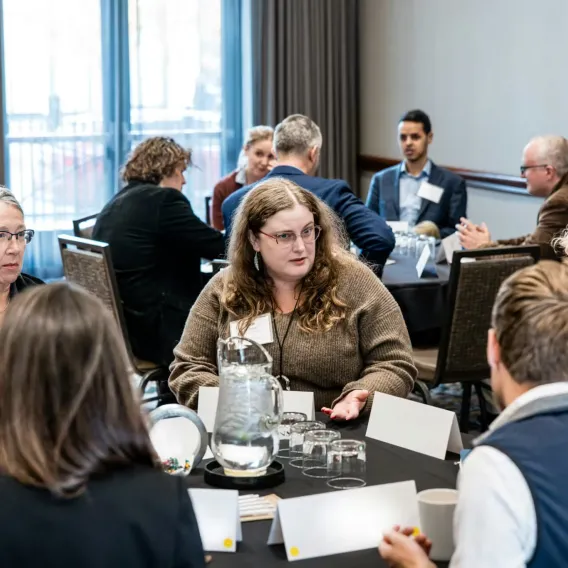
What particularly appealed to Alicia about Bastiat was its flexibility. "We kind of got to rank what we wanted to do and then we're able to go to four different weekends and it didn't have to be the same four for everybody. I was able to take one on, I don't remember what we did, but it was a lot of Ostrom, which is really neat. And then I had another one was entrepreneurship, which was really neat."
The Ostrom readings proved transformative. "I had never read Ostrom before, which was just shocking for someone in this world. But it was fantastic. Like that really opened up my mind where I was like, a lot of stuff is really making sense now. And that was probably my favorite moment was just my mind sort of opening up with that particular set of readings."
After graduating, Alicia worried about losing connection to this intellectual community. The James Buchanan Fellowship, a one-year program for early-career scholars who recently completed their doctoral programs, provided the solution. "I was afraid that after I had graduated, there was no more way for me to keep working with these really cool, interesting people I had met over time." Even though first-year faculty life made the commitment difficult, she participated because "I was only willing to do that because of the cool stuff from Bastiat."
Buchanan deepened professional relationships at a crucial career stage. "Me and Nathaniel Burke had met before in Bastiat. We didn't become friends really until Buchanan. And now we work at the same school and we published together."
The Mercatus experience that I did was so much fun that I want to give that same experience to other people.

The fellowships' influence extends beyond Alicia's research to how she runs her center. "That was such a great way to bring in different students, to have them have conversations and really have them think, that's the whole reason we have book clubs here now, is because the Mercatus experience that I did was so much fun that I want to give that same experience to other people." She now sees PhD students as colleagues rather than just students, a shift she attributes directly to her Mercatus experience.
To prospective fellows, especially those from schools outside the network, Alicia is emphatic: "I was in a school that was not in the network, which means we never had these discussions. We never talked about Ostrom. We never talked about Mises or Smith or anything like that. I never knew any of this stuff or had conversations about this stuff."
Her advice is practical: "Just jumping with both feet. Take it seriously and actually do the readings, because the people who didn't do the readings, I think, did not get nearly as much out of it. Stay around for the happy hours, because sometimes the lunches and happy hours have better conversations than even the discussions that we were having in the room."
For Alicia, the fellowships provided more than education, they provided the network, the theoretical grounding, and the intellectual community that continue to shape her work today.