Benedikt Schmal's Mercatus Fellowship Story
Bridging Quantitative Methods and Political Economy: How the Oskar Morgenstern Fellowship Helped Benedikt Schmal Become "a Better Economist"


undefinedundefined
hen Benedikt Schmal joined the Oskar Morgenstern Fellowship as a PhD student in industrial economics, he came with a strong background in game theory and quantitative methods. What he sought was broader academic horizons and exposure to American academic culture. What he found was transformative. "I realized the boundaries of this economic understanding of causality," he reflects. "You need to take this inside out perspective and try to look from the eyes of the individual instead of the omniscient researcher that looks from above." Today, Benedikt credits the fellowship with making him "a better economist," one who can approach problems with entrepreneurial thinking and multiple perspectives.
Every flight back, I started writing something down, notes for a new paper.
As a PhD student in industrial economics, Benedikt saw the Oskar Morgenstern Fellowship as an opportunity to broaden his academic horizons and experience American academic culture firsthand. The fellowship proved transformative for both his research approach and his intellectual development.
The Oskar Morgenstern Fellowship is a one-year online program for scholars, practitioners, and graduate students from any discipline with interest in political economy and emerging technologies such as artificial intelligence. Fellows explore how the Austrian, Virginia, and Bloomington schools of political economy address questions regarding institutions, progress, governance, and the potential and limitations of emerging technologies.
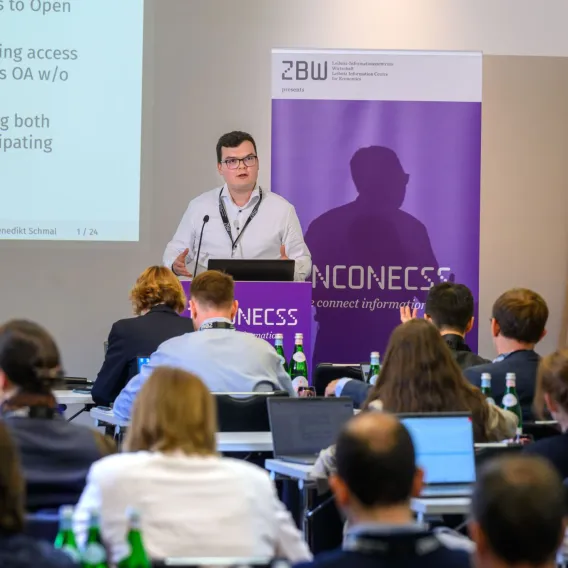
I really had the feeling that it's like you can make any argument and it's really like a free speech experience.
The fellowship fundamentally changed how Benedikt approaches research questions. Reading works by scholars like Elinor Ostrom introduced him to entirely new ways of thinking about economic problems. "It sparked this new idea of institutional industrial economics and the idea that we have to look into the governance of firms and governance of markets," he says. "Reality is so much richer and thicker than what we see in these industrial economic models."
This shift in perspective led directly to new publications. Benedikt published a paper in the Journal of Institutional Economics on polycentric governance in business cartels, and another in the Journal of Competition Law and Economics treating cartels as common pool resources. "It heavily influenced my publishing. It basically created a new publishing stream," he explains. The fellowship's impact was so immediate that "every flight back, I started writing something down, notes for a new paper. Every flight back was something like I was working as long as I fell asleep."
In his research, Benedikt applied concepts from the Bloomington School to understand how polycentricity might stabilize cartels and affect their punishment, using the Institutional Analysis and Development (IAD) framework developed by the Ostroms. "I theoretically derived and also showed like game theoretical modeling and quantitative decomposition of profits, I demonstrated that it's like a common pool resource. And if it's a common pool resource, we can apply the IAD framework," he explains.
It was especially helpful to talk to people who were not economists because they had [...] different view[s] on how to approach a question.
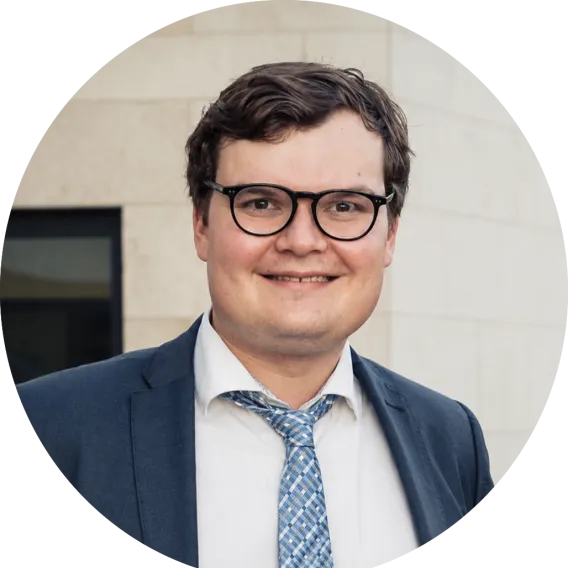
Beyond the intellectual content, Benedikt valued the fellowship's discussion format and open intellectual environment. "I really had the feeling that it's like you can make any argument and it's really like a free speech experience," he says.
The interdisciplinary nature of the fellowship proved especially valuable. "It was especially helpful to talk to people who were not economists because they had a fresh view," Benedikt notes. "They had a different view of the world and also not only different view of the world but different view on how to approach a question." This exposure to scholars from fields like microbiology, theology, and sociology prevented him from becoming "blinded by your own discipline."
Benedikt's work demonstrates how the Oskar Morgenstern Fellowship equips scholars with new frameworks and perspectives creating researchers who can bridge quantitative methods with institutional analysis and approach complex problems from multiple angles.