César Báez’s Mercatus Fellowship Story
From Venezuela to Content: How the Don Lavoie Fellowship Helped César Báez Find His Voice in Storytelling

undefinedundefined
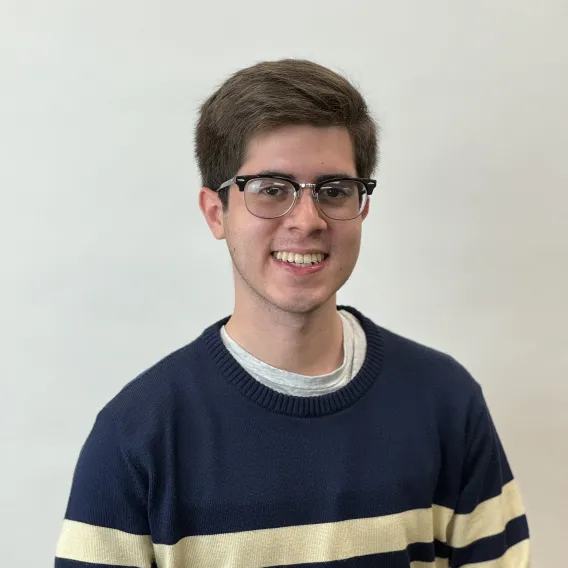
hen César Báez finally received his Mercatus fellowship books after a two-month ordeal involving government mail services, military checkpoints, and a police interrogation in San Cristóbal, Táchira, he felt more than relief. "I remember I opened the box, put everything on the floor and took pictures," he recalls. "I posted that on Instagram and tagged Mercatus and I was really excited because I felt like a win for me. I surpassed all the surveillance and control and repression. Finally, I'm going to be able to learn." That moment captured what the Don Lavoie Fellowship meant for César as a law and political science student in Venezuela: access to ideas that simply weren't available in his country. Today, as a documentary producer creating content about Venezuelan immigration and Latin American policy, César credits the fellowship with giving him the intellectual tools and frameworks he applies daily to his storytelling work.
I was really excited about the chance, not just to be connected with Mercatus, but also having the chance to learn with people that I consider like idols, [...] people that you heard about on websites or books, but having the chance to actually connect with them, discuss ideas, ask questions.
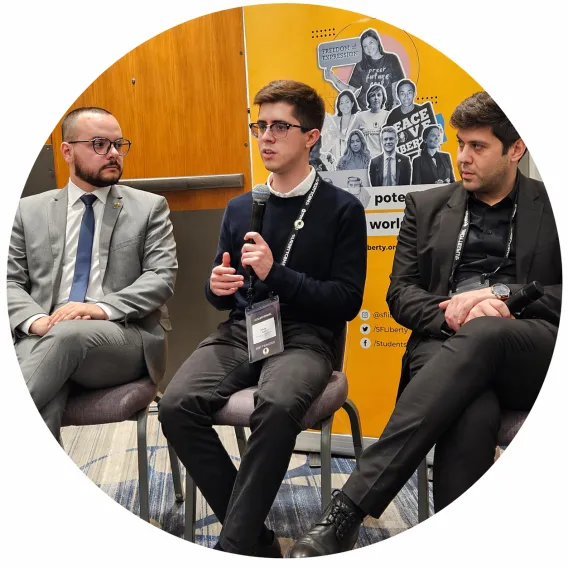
César discovered the Lavoie Fellowship through Instagram ads while he was in Venezuela involved with Students for Liberty. "I was really excited about the chance, not just to be connected with Mercatus, but also having the chance to learn with people that I consider like idols, like Pete Boettke or Virgil Storr, people that you heard about on websites or books, but having the chance to actually connect with them, discuss ideas, ask questions," he explains.
The Don Lavoie Fellowship is an online, semester-long program for undergraduate students, recent graduates and young professionals considering graduate school, and early-stage graduate students interested in political economy. Through online discussions with peers and scholars, fellows explore key ideas in the Austrian, Virginia, and Bloomington schools of political economy and discover how to apply these frameworks to academic and policy research. The fellowship's online format makes it accessible to students worldwide, creating a global community of learners.
This is an amazing opportunity to engage with ideas. And this is an opportunity that you don't get in many places. You don't get just reading books, watching videos, watching lectures on YouTube. This is an actual opportunity to engage with the people that write these very influential books.
For César, the fellowship was transformative precisely because these ideas weren't discussed in Venezuela. "Mainstream academia in Venezuela is very lefty and academia is actually destroyed in general because public universities don't get enough funding, private universities don't have enough students," he says. "There was no way for me to learn all the things that I was actually passionate about."
César participated in the Lavoie Fellowship for two years. First, while still in Venezuela, then after immigrating to the United States. His favorite aspects were the global conversations. "You get the chance to talk with people from so many different countries, so many different contexts," he says. "Most of my interventions were trying to connect my context or the knowledge that I had as a Venezuelan and try to share with other people."
Among his favorite readings, The Clash of Economic Ideas by Lawrence H. White stood out. "It was a great introduction to the economic debate in general and I had the chance to actually see everything as a timeline of events. I can identify people and certain ideas and how these ideas evolved through time. That was wonderful for me."
Everyone that's interested in understanding how society works and what are the biggest challenges probably holding society from achieving its full potential should definitely consider applying.

But it was Chris Coyne's work that would most directly shape César's career. "Doing Bad by Doing Good by Chris Coyne, that's definitely one book that has inspired me a lot," he explains. He produced a documentary about Venezuelan immigration in New York City, examining how well-intentioned government policies, free housing, shelters, but no work authorizations end up hurting the migrants they're meant to help. "It's basically a story like that. It's the government thinking that they're doing something good for people that are actually in a state of need, but they're hurting them. They're not letting people basically unleash their entrepreneurial spirit to find innovative ways to solve problems."
Today, César creates both short-form content for social media and long-form documentaries focused on Latin America. "I feel strongly Latin American and I'm not giving up on that identity," he says. "There's millions of people suffering because of dumb or actually evil government decisions all over the place. I like to continue sharing these stories, talking about great things that entrepreneurs are doing, through documentaries, through short stuff on TikTok, through articles."
To prospective fellows, César offers straightforward advice: "This is an amazing opportunity to engage with ideas. And this is an opportunity that you don't get in many places. You don't get just reading books, watching videos, watching lectures on YouTube. This is an actual opportunity to engage with the people that write these very influential books." He emphasizes that the fellowship isn't just for economists: "Everyone that's interested in understanding how society works and what are the biggest challenges probably holding society from achieving its full potential should definitely consider applying."