Doug Norton’s Mercatus Fellowship Story
Teaching the Future to Think Clearly: Doug Norton on how Mercatus fellowships prepared him to pass on enduring ideas in the classroom.


undefinedundefined
hat Doug Norton found when he joined the inaugural class of the Adam Smith Fellowship as a first-year PhD student at Florida State University transformed not just his graduate education, but his entire approach to teaching and scholarship. Today, as faculty in the Department of Economics and Director of the Philosophy, Politics, and Economics program at Florida State, Doug teaches over 300 students each year, exposing them to the interdisciplinary thinking, institutional analysis, and appreciation for complexity he first encountered at Mercatus.
Doug Norton joined the inaugural class of the Adam Smith Fellowship with one simple desire: to talk about big ideas. "I was just wanting to have different kinds of economic conversations," he recalls, "less about the mathematical modeling and more about just trying to understand the way the world works and hearing different ideas."
There is not just one field that's going to be able to say significant things about it. It's going to take all of us.
The Adam Smith Fellowship is a one-year program that brings together doctoral students from different universities and disciplines. Through collaborative discussions exploring the Austrian, Virginia, and Bloomington schools of political economy with peers and leading scholars, fellows discover how market process economics, public choice theory, and institutional analysis can shed light on questions about human flourishing and social change.

If you think that information and incentives are important in public policy, and you want that to be relayed to a large number of people, well, that happens in the classroom.
What Doug found was a program that not only expanded his intellectual horizons but deeply shaped his teaching philosophy. "Absolutely. I mean, there's no doubt about it," he says when asked if the fellowship has influenced his work. His students benefit from what he first encountered through Mercatus: a tradition that embraces complexity, interdisciplinary collaboration, and the importance of discovery. "These problems are high-dimensional problems," Norton says. "There is not just one field that's going to be able to say significant things about it. It's going to take all of us."
Norton describes how the fellowship's interdisciplinary environment helped him see new angles on policy issues and public challenges. "Certainly one of the impressions I was left with was that people coming from political science or coming from philosophy... they can see things in very different ways," he says. That perspective fundamentally changed the way he approaches his own teaching and scholarship, particularly in how he encourages students to examine trade-offs, unintended consequences, and institutional design.
I would just tell them, 100%, it will be one of the most intellectually exciting experiences that you'll ever have in graduate school.
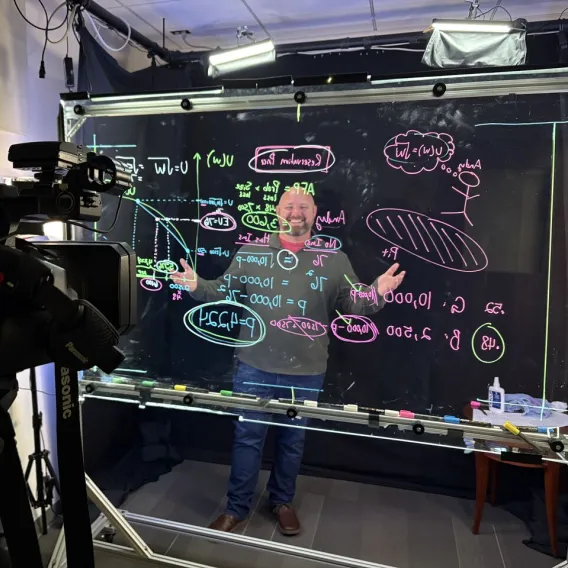
But perhaps the clearest outcome of his Mercatus experience is the deep seriousness with which he now teaches students to think, not just about markets, but about governance and complexity itself. "If you think that information and incentives are important in public policy, and you want that to be relayed to a large number of people, well, that happens in the classroom," Norton says. And it's in the classroom where students begin to question assumptions: "That idea sounds really attractive until you think about the problems of public choice… until you realize that you don't have the requisite information."
For prospective fellows, Norton offers unqualified encouragement: "I would just tell them, 100%, it will be one of the most intellectually exciting experiences that you'll ever have in graduate school."