Gianna Englert's Mercatus Fellowship Story
Recovering Liberalism’s Economic Roots: How Political Economy at Mercatus Helped Gianna Englert Reframe the History of Democratic Thought


undefinedundefined
hen Gianna Englert joined the Adam Smith Fellowship as a Georgetown PhD student, studying 19th-century liberalism, she began a quest to understand economic liberalism's role in democratic thought that has shaped her entire career trajectory. From publishing research on Hayek to teaching philosophy, politics, economics, and law at the University of Florida's Hamilton Center.
For Gianna Englert, the Adam Smith Fellowship came at a formative moment in her academic journey. As a PhD student at Georgetown University studying political theory, she was deep in dissertation work on 19th-century liberalism. Specifically, how liberal thinkers reacted to the rise of universal suffrage after the French Revolution. She was drawn to the period because “this is kind of the hotbed of liberalism converging with democracy… about the value of democracy, about the viability of democracy, things that I actually think are really current concerns”
The Adam Smith Fellowship is a one-year program that brings together doctoral students from different universities and disciplines. Through collaborative discussions with peers and leading scholars, fellows discover how market process economics, public choice theory, and institutional analysis illuminate questions about human flourishing and social change.
I don’t know anywhere else where people are getting to read Hayek and Mises and Buchanan.
The fellowship provided Gianna with a new lens through which to explore those same questions. “I don’t know anywhere else where people are getting to read Hayek and Mises and Buchanan and take these really seriously as interlocutors with figures that they read in their own work,” she said. “The substance attracted me immediately. I wanted to learn more about these names I'd heard, but really didn't know much about.”
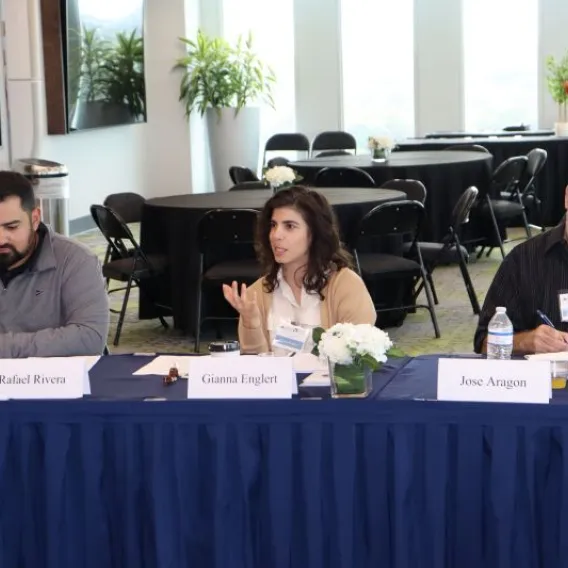
I think you can really see the fingerprints of the Adam Smith Fellowship on what I publish and what I write about.
But what made the Adam Smith Fellowship especially meaningful wasn’t just what she read; it was how she read it, and with whom. The program’s format, which brings together a cohort multiple times throughout the year, created something rare in academia: continuity and camaraderie. “What really started from these deep conversations I think has spun out,” Gianna shared. “Now what—seven or eight years since I did the fellowship—I could list off right now quite a few people that I've spoken to from the fellowship just this week.”
Those relationships weren’t just personal. They’ve had a lasting impact on her academic career. Gianna credits the fellowship with giving her “this missing piece of political economy and thinking about the liberal tradition that I think political theorists often miss.” She added, “If we're actually mapping the history of liberalism, we ought not ignore this very influential tradition of economic liberalism that people like Hayek and Mises and the Austrians represent”.
Today, Gianna is an Associate Professor of Humanities at the University of Florida’s Hamilton Center for Classical and Civic Education. Her research now includes work on Hayek and his role in shaping modern liberal thought, a direct result of the fellowship’s influence. “I've already published on Hayek. I'm working on another piece about Hayek,” she said. “So, I think you can really see the fingerprints of the Adam Smith Fellowship on what I publish and what I write about.”
You’ve got an opportunity to have important discussions both in the colloquia but surrounding everything else that happens during the colloquia weekends.
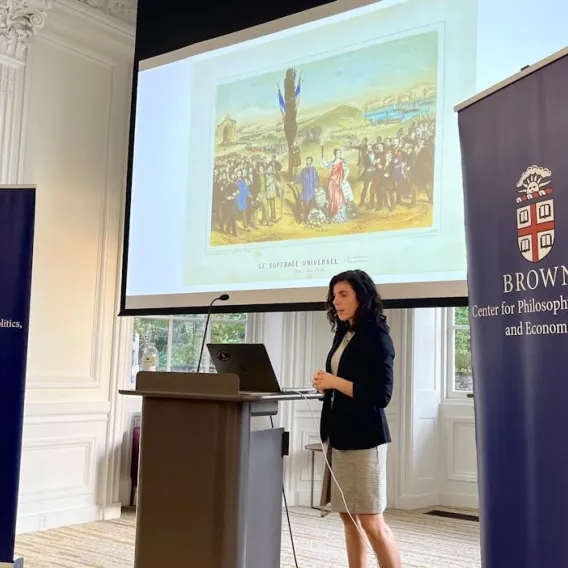
And those intellectual tools are helping her in the classroom too. “Being able to not only do one of the P's of the PPE (Philosophy, politics and economics)—the political theory or the political science portion—but actually contribute to the political economy… this is something that I think the Mercatus Center positioned me to do through the fellowship.”
If there’s one message Gianna hopes to pass along to future fellows, it’s to take full advantage of everything the experience has to offer. “Go there knowing that you’ve got an opportunity to have important discussions both in the colloquia but surrounding everything else that happens during the colloquia weekends,” she advised. “Think of these as making meaningful connections in academia—connections that are really going to serve you throughout later parts of your career.”