James Rice’s Mercatus Fellowship Story
How Mercatus Shaped a Scholar's Path


undefinedundefinedhen James Rice started college, he had no plans to study economics. “I thought I wanted to study biology or chemistry because it seemed analytical and it seemed interesting and logical”, but a freshman-year course changed that. “When I went to college for the first time in the spring semester of my freshman year, I took an agricultural and resource economics course. And that course changed the way I thought about everything. And it changed my entire career direction because actually, despite the fact that I had this sort of underlying interest in politics and history and sociology and economics throughout my younger years, in high school, that didn't really manifest it…But then when I took that economics class, I realized that this was a field of study, economics primarily, that addressed those underlying interests that I've had since I was a young child”.
I think Mercatus is one of those places where the exchange of ideas is front and center in everything that the fellowships do.
His undergraduate in Economics at the University of Connecticut was highly quantitative, “I felt I didn't get the theoretical aspects of economics and the historical aspects and the sociological aspects of economics from my undergraduate degree,” he explains. “And I wanted to move back towards being this sort of well-rounded theoretical but also empirically savvy political economist”. It was this urge to further his own interest that drew him to Mercatus and in 2023 he was accepted to the Frédéric Bastiat Fellowship. “I knew as soon as I got accepted that I wanted to do it,” he says. “I knew it completely aligned with my interests”.
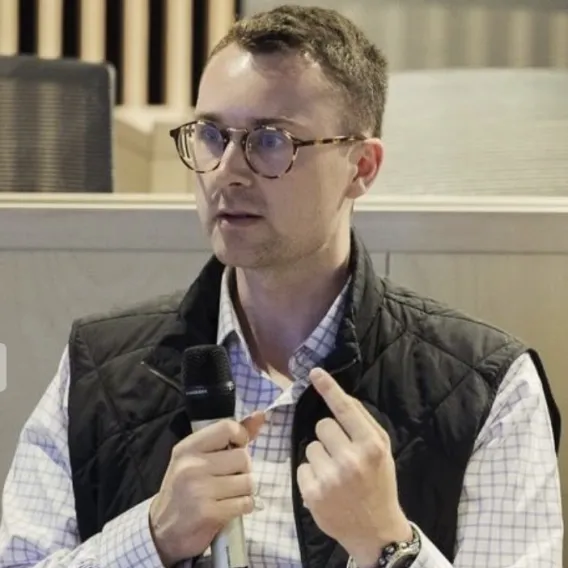
If I didn't understand the ways that classical liberalism and mainline political economy operate in the academic space today, I would never have the opportunity to edit a volume of Cosmos and Taxis.
The Frédéric Bastiat Fellowship was a one-year program that brought together graduate students from different universities and disciplines, including economics, law, political science, and public policy. Through collaborative discussions fellows explored how the Austrian, Virginia, and Bloomington schools of political economy provide foundations for contemporary policy analysis and apply to real-world challenges.
He arrived with a limited background in the field. “I didn't know who Gordon Tullock was or James Buchanan. I don't think I'd ever heard the name Elinor Ostrom before, although she is a Nobel Prize winner in economics. And now I do”.
What stood out to him most was the culture of the fellowship. “I think Mercatus is one of those places where the exchange of ideas is front and center in everything that the fellowships do,” he says. “One of the things that I was most surprised at was how welcoming they were to different ideas and to dialogue across different types of ideological standpoints that fellows come in with”.
After finishing the Bastiat Fellowship James continued his engagement with Mercatus with the Ronald Coase Fellowship, which was a one-year, online program for graduate students from any university and academic discipline, “I learned so much during them [the virtual sessions for Coase]. I always try to share my ideas. Like it's interesting to talk to the other fellows. Many of the other fellows I've connected with outside the fellowship. We see each other on the virtual forum. We also are connected on LinkedIn. I see people who are leading different conferences in different places around Europe. And so, it's actually quite nice”.
You don't have to work in the mainline tradition to make a contribution to political economy. Mercatus can help you be successful where you are because of the exposure to ideas and because of the exposure to debate and dialogue.

The influence has continued well beyond the fellowships. “Now I get so much information from Mercatus. I shaped my viewpoint about different kinds of popular issues based on the ways that Mercatus scholars are thinking about these things, not because I'm relegating my ideas to them, but because I think that the ideas that come out of Mercatus are really valuable”. Those connections have also opened professional doors. “If I didn't understand the ways that classical liberalism and mainline political economy operate in the academic space today, I would never have the opportunity to edit a volume of Cosmos and Taxis”. He also notes that his work with a colleague he met through the Hayek program at the London School of Economics would not have happened “if it hadn't been for the Mercatus”.
His experience has also shaped how he teaches. In his spring theory course at University College London, he used the seminar model he learned at Mercatus. “There would be no hierarchy between me and the students,” he explains. “The way Mercatus does it is the way it should be done in many cases. And it's certainly the way that I try to run my classrooms”.
He encourages prospective fellows to take the program's reading seriously and to use it beyond the seminar room. “Mercatus sends you a lot of books. So, you know, if you feel so inclined, read the books because they're free and they're interesting”. He also reminds them that the fellowship is not only for those who work in the mainline tradition. “You don't have to work in the mainline tradition to make a contribution to political economy. Mercatus can help you be successful where you are because of the exposure to ideas and because of the exposure to debate and dialogue”.
Today, James Rice is a PhD candidate in Government at the University of Essex, where he is also a fixed-term lecturer in computational social science. He is also a postgraduate teaching assistant at University College London, where he teaches courses on public policy and ethics.
For him, the value of the fellowship is more than knowledge. "Obviously, I have the credentials to show that I'm invested in this movement, and I'm invested also in the ideas that Mercatus relies on to do their work,” he says. “And so, I think that makes me more credible in this space…It would be really sad for me not to have this community”.