- | Labor Markets Labor Markets
- | Federal Testimonies Federal Testimonies
- |
AI and the American Workforce
Evidence, measurement gaps, and a path forward
US Senate Committee on Health, Education, Labor, and Pensions
Subcommittee on Employment and Workplace Safety
The Impact of AI on the Workforce
Good morning, Chairman Banks, Ranking Member Hickenlooper, and members of the Subcommittee on Employment and Workplace Safety. It is an honor to testify before you.
My name is Liya Palagashvili, and I am a senior research fellow and director of the Labor Policy Project at the Mercatus Center at George Mason University. I am a labor economist whose research examines how labor markets evolve and how public policy can help workers adapt to market changes.
Today, my testimony makes four points regarding AI and the workforce:
- The early evidence does not yet show broad AI-driven employment loss. Instead, AI appears to be affecting the labor market through several channels at once: automating some tasks, augmenting others, increasing productivity and demand for complementary work, and changing how firms organize production. The clearest evidence of potential concern is concentrated among younger workers entering highly exposed occupations, but the extent to which AI is responsible remains uncertain.
- Federal labor-market statistics are not yet equipped to measure these changes well. Worker surveys do not show how AI is changing tasks within jobs, business surveys are not routinely linked to hiring and earnings outcomes, and timely measures of independent work remain limited. The AI Workforce PREPARE Act would be a step in the right direction by helping to close some of those gaps.
- My research identifies a separate and less visible margin of adjustment. Since early 2024, nonemployer-type business applications and solo self-employment have risen disproportionately in AI-exposed sectors and occupations. These patterns are descriptive rather than causal, but they suggest that some work may be shifting from employment within firms toward independent work.
- Congress can strengthen workers’ capacity to adapt. Benefits and income-security protections should travel across jobs, clients, and work arrangements. Policy reforms can also reduce tax barriers to employer-led training and move toward greater neutrality between investment in machines and investment in people.
1. What the Early Evidence Shows
Much of the public debate over AI and jobs begins with a binary question: Will AI take this job? Economists typically approach the question differently. A job is a bundle of tasks, and automating some tasks does not imply that the whole occupation disappears. The employment effect depends not simply on what AI can do, but on which tasks are automated, how the remaining tasks fit together, whether productivity gains expand demand, and how work is reorganized around tasks.1
The evidence to date does not show broad AI-driven employment loss. Several studies find little discernible change in aggregate employment or unemployment associated with generative AI, while linked administrative evidence finds little effect on earnings or hours at AI-adopting workplaces.2A recent Federal Reserve staff analysis similarly concludes that the economy remains in an AI buildout phase, with rapid advances in capabilities, investment, and adoption but with labor-market effects that remain concentrated rather than broadly based.3
At the firm level, the evidence points to both displacement and expansion. AI may reduce demand for some tasks, but productivity gains can increase output and demand elsewhere within the firm.4Experimental evidence from startups likewise shows gains in task completion, customer acquisition, and revenue without a reduction in labor demand.5
Nationally representative business data point to the same mixed pattern. About 95 percent of AI-using firms report no change in total employment. Among firms reporting task-level effects, AI is used far more often to augment workers than to replace their tasks, while new-task creation occurs at roughly the same rate as task replacement.6These findings do not imply that displacement will not occur in the future. They do show why task automation should not be treated as equivalent to job loss.
The clearest evidence of potential concern is concentrated among younger workers entering highly AI-exposed occupations. Two recent studies find signs of weaker job entry for workers ages 22 to 25, although neither finds broad increases in unemployment among highly exposed workers.7
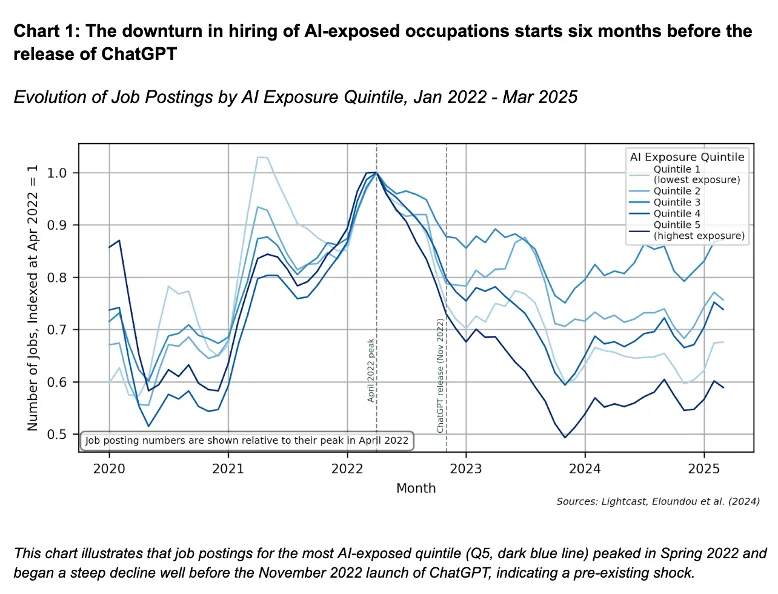
These findings warrant continued attention, but they do not yet establish that AI is the primary cause of weaker entry-level outcomes. Hiring in many highly exposed occupations began declining before the release of ChatGPT, while employment outcomes have also weakened among young workers in groups with relatively little exposure to AI.8These broader patterns suggest that macroeconomic and other economy-wide factors may account for part of the observed slowdown. As chart 1 from the Economic Innovation Group shows, job postings in the most AI-exposed occupations peaked in spring 2022 and began declining before ChatGPT’s release.
The evidence of weaker entry-level outcomes is based in part on Automatic Data Processing (ADP) payroll data. Those records provide a detailed view of employment within covered firms, but they do not capture whether young workers who do not enter payroll jobs move instead into self-employment, independent work, or new business formation. A decline in payroll employment may therefore reflect not only weaker labor demand, but also movement into forms of work that fall outside employer payrolls. My own research finds that self-employment and solo-type business formation have risen disproportionately in AI-exposed sectors and occupations.9Other recent research similarly finds stronger business-entry activity in more AI-exposed industries, although it does not isolate the solo-business margin.10
The evidence therefore supports a more cautious conclusion. AI may be displacing some tasks, expanding demand for others, changing the composition of hiring, and altering the boundaries of firms at the same time. Existing employment statistics cannot yet tell us how important each of these margins is.
2. The Measurement Gaps in AI and Work
Every federal data source I have cited provides valuable information, and the statistical agencies have made important progress. But measuring AI’s labor-market effects is unusually difficult. Definitions vary across surveys. Some workers may not know that AI is embedded in the software they use. The intensity and purpose of AI use differ substantially across workplaces. And AI capabilities are changing faster than many federal surveys can adapt.11
Two measurement gaps are especially important for this subcommittee. First, federal household surveys tell us whether someone is employed and what occupation that person holds, but not how AI is changing the tasks within the job. They also cannot tell us whether a move into self-employment reflects a new opportunity, a response to reduced payroll hiring, or some combination of the two.
Second, business surveys can tell us whether a firm reports using AI, and sometimes whether the firm says AI affected employment, but those responses are still too coarse and are not routinely linked to hiring, separations, earnings, or occupational composition. Even the basic rate of AI adoption depends heavily on how the question is asked. When the Census Bureau broadened its survey language in November 2025 from AI used “in the production of goods or services” to AI used “in any business function,” reported use rose from 10 percent to 17 percent.12That increase reflected a change in measurement, not a sudden month of economic transformation.
The bipartisan AI Workforce PREPARE Act moves in the right direction on several of these fronts already. It adds new AI-use questions into the Current Population Survey, the Annual Business Survey, and the Business Trends and Outlook Survey, and it creates a voluntary channel for AI developers and deployers to share adoption data with statistical agencies. As Congress refines and implements the legislation, I would emphasize five priorities.13
- Connect business adoption to labor-market outcomes. The act already directs new AI-use questions into the Annual Business Survey and the Business Trends and Outlook Survey, but those responses are not routinely linked to hiring, separations, earnings, or occupational composition. Congress could direct secure linkage of those survey responses to Longitudinal Employer-Household Dynamics data, so outcomes can be compared directly between AI-using and non-AI-using firms.
- Improve occupation-level administrative data. Better occupational information in the Quarterly Workforce Indicators would allow researchers to identify, at a scale that household surveys cannot support, which kinds of work are expanding or contracting.
- Build a timely “likely nonemployer” series. The Business Formation Statistics already flag “likely employer” applications by linking SS-4 EIN applications to the Longitudinal Business Database. An analogous link to the Nonemployer Statistics database could produce a “likely nonemployer” series—the underlying microdata are already there, and Census researchers have previously identified this as promising future work. A separate, complementary effort, building on Census’s own prototype work identifying AI-related applications through text analysis of business names and descriptions, could turn that research exercise into a standing, regularly published series that flags which business applications are AI-related, including whether they are likely to become employer or nonemployer businesses.
- Measure AI use from the worker’s perspective, and go beyond adoption. The Current Population Survey questions that the act already directs should ask not just whether workers use AI, but which tasks it affects and whether it has changed their duties, hours, training needs, or work arrangements.
- Consolidate what different agencies already know. My colleague Revana Sharfuddin has recommended that the Bureau of Labor Statistics (BLS), the Census Bureau, the National Science Foundation (NSF), and the National Institute of Standards and Technology (NIST) jointly produce an annual AI-and-workforce indicators report, since each agency holds only part of the picture. The act’s Artificial Intelligence Workforce Research Hub is a natural home for this project. Congress should expand its required collaborators beyond Census, the Bureau of Economic Analysis, and BLS to include NSF and NIST, so the Hub’s recurring output functions as that consolidated report rather than one more stand-alone product.
These proposals build on surveys and administrative systems that already exist. Some would take time and resources to implement, but they are practical extensions of the current statistical system. Without them, Congress will continue to receive widely different estimates of AI adoption and incomplete accounts of its labor-market effects. Estimates of the share of businesses using AI in 2025 alone range from 9 percent to 78 percent, depending on the source of the data and definition of AI use.14
The objective is not to produce one definitive measure of AI’s effect. It is to build a system in which worker surveys, business surveys, and administrative records answer distinct but complementary questions.
3. A Different Margin of Adjustment: AI and the Organization of Work
My research examines whether AI exposure is associated with growth in independent work and self-employment. Rather than asking only whether AI is reducing employment, I ask whether generative AI is lowering the cost of operating outside a firm and making independent, solo-run work more feasible in knowledge-intensive fields.
Using Census Bureau Business Formation Statistics, I construct a proxy for business applications that lack the Bureau’s indicators of near-term payroll intent—businesses less likely to hire employees. As figure 2 shows, these nonemployer-type applications tracked closely with a comparison group through 2023, then diverged sharply: From the first quarter of 2024 to the first quarter of 2026, they rose 26.8 percent in AI-exposed sectors—professional services, information, education, and finance and insurance—compared with a decline of 0.4 percent in a comparison group of construction and wholesale trade.15
Over the same period, high-propensity applications—those more likely to become employer firms—fell 6.4 percent in the AI-exposed group. Growth was therefore concentrated in filings without signs of near-term hiring, not in employer-type business formation.
Current Population Survey data show the same broad pattern. Solo self-employment, which is defined as self-employed workers with no paid employees, also rose faster in AI-exposed industries than in the comparison group over this period. The sharper result, shown in figure 3, is by occupation: Solo self-employment rose 20 percent among the 10 most AI-exposed occupations from the 2022–2023 baseline to 2025, while it was essentially unchanged among the 10 least-exposed occupations.16
Management analysts—the occupation closest to consulting-type work—provide a useful example. Overall employment in the occupation continued to grow, while the share working as solo self-employed rose from 5.6 percent in the 2022–2023 baseline to 7.0 percent in the first quarter of 2026. This is consistent with an occupation being reorganized rather than displaced.
These results should be interpreted cautiously. They are descriptive, not causal, and can neither establish that AI caused the observed divergence nor rule out other sector-specific shocks. They are, however, consistent with the idea that generative AI lowers the cost of working independently by providing research, drafting, coding, analysis, design, and communications support that previously required coworkers or firm infrastructure.
By reducing the complementary inputs needed to produce a marketable service, AI may lower the minimum efficient scale of some forms of knowledge work. This does not mean firms are disappearing. It suggests that, at the margin, some work may shift from employment within firms toward contracting and solo production. If that mechanism is operating, an early labor-market signal may be an application for an Employer Identification Number rather than a layoff notice.
The larger point is not that AI is necessarily causing a shift into independent work, but that job loss is only one possible margin of the labor market’s adjustment to AI. A complete assessment of AI’s effects must also examine whether work is moving across firm boundaries and into self-employment.
4. A Path for Congress
Better measurement is a prerequisite for sound policy, but the policy implications are not limited to measurement. Two areas stand out.
First, Congress should continue modernizing benefits so that they travel with the worker rather than staying behind with a single employer. A shift from payroll employment to independent work can leave total employment unchanged while moving workers outside the employer-sponsored benefits system. As of July 2026, 10 states have enacted voluntary portable-benefits frameworks that provide a safe harbor for independent workers accessing benefits. The laws differ in their details, but they share a basic principle: A contribution to a worker-owned benefits account should not, by itself, determine whether that worker is an employee or an independent contractor.17Congress can provide the same clarity under federal law.
Second, Congress should restore neutrality between investment in machines and investment in people.18Businesses can immediately deduct the full cost of equipment, but training gets no comparable treatment—capped at $5,250 per employee, and often disqualified if it meets minimum job requirements or prepares a worker for a new role. Congress recently made that cap permanent and inflation-indexed, a useful step, but the asymmetry remains. If automation leaves workers doing more judgment-intensive work, the tax code should make investing in their training as easy as investing in the machine. 19
Conclusion
The evidence to date does not support a simple story of AI replacing workers at scale. AI can reduce demand for some tasks while increasing productivity, creating complementary work, and changing how firms organize production. The early evidence on younger workers warrants attention, but slower entry into highly exposed payroll occupations is not the same as broad displacement, especially when payroll data cannot capture movement into independent work or self-employment. My own research suggests that this last margin may matter more than current statistics show.
That is why measurement matters. Congress needs data that can distinguish exposure from adoption, and task substitution from changes in how work is organized. The AI Workforce PREPARE Act would help close some of those gaps. The policy implications also extend beyond measurement. The tax code and benefits system should keep pace with how people actually work today.
Thank you again for the opportunity to testify. I look forward to your questions.
Notes
[1] Daron Acemoglu and Pascual Restrepo, “Automation and New Tasks: How Technology Displaces and Reinstates Labor,” Journal of Economic Perspectives 33, no. 2 (2019): 3–30; David H. Autor and Neil Thompson, “Expertise” (NBER working paper no. 33941, National Bureau of Economic Research, June 2025); Joshua S. Gans and Avi Goldfarb, “O-Ring Automation” (NBER working paper no. 34639, National Bureau of Economic Research, January 2026); James Bessen, “Automation and Jobs: When Technology Boosts Employment,” Economic Policy 34, no. 100 (2019): 589–626.
[2] Jonathan S. Hartley, Filip Jolevski, Vitor Melo, and Brendan Moore, "The Labor Market Effects of Generative Artificial Intelligence and Job Loss Fears," July 21, 2026; Martha Gimbel et al., “Evaluating the Impact of AI on the Labor Market: Current State of Affairs,” The Budget Lab at Yale, 2025; Anders Humlum and Emilie Vestergaard, “Still Waters, Rapid Currents: Early Labor Market Transformation under Generative AI” (NBER working paper no. 33777, National Bureau of Economic Research, April 2026).
[3] Paul E. Soto et al., “The AI Buildout and the Economy: Publicly Available Data to Assess AI’s Impact,” FEDS Notes, Board of Governors of the Federal Reserve System, July 17, 2026. The authors conclude that the available indicators are more consistent with an AI buildout phase than with the onset of broad-based labor displacement; the views expressed are those of the authors and do not necessarily represent the Board of Governors.
[4] Menaka Hampole et al., “Artificial Intelligence and the Labor Market” (NBER working paper no. 33509, National Bureau of Economic Research, February 2025).
[5] Hyunjin Kim et al., “Mapping AI into Production: A Field Experiment on Firm Performance” (INSEAD working paper no. 2026/20/STR, INSEAD Business School, April 2026).
[6] Kathryn Bonney et al., “The Microstructure of AI Diffusion: Evidence from Firms, Business Functions, and Worker Tasks” (NBER working paper no. 35141, National Bureau of Economic Research, July 2026). The authors report that more than 95 percent of AI-using firms experienced no change in total employment; 44 percent used AI to augment workers, 10 percent to replace tasks, and 11 percent to create new tasks.
[7] Erik Brynjolfsson et al., “Canaries in the Coal Mine? Six Facts about the Recent Employment Effects of Artificial Intelligence” (working paper, Stanford Digital Economy Lab, November 2025); Maxim Massenkoff and Peter McCrory, “Labor Market Impacts of AI: A New Measure and Early Evidence,” Anthropic Economic Research, last updated March 8, 2026, https://www.anthropic.com/research/labor-market-impacts. The authors find no systematic increase in unem-ployment among highly exposed workers and tentative evidence of a decline in job entry among workers ages 22–25.
[8] Zanna Iscenko and Fabien Curto Millet, “Looking for the Ladder: Is AI Impacting Entry-Level Jobs?,” Economic Innovation Group, January 14, 2026; Adam Ozimek and Nathan Goldschlag, “AI and Young-Adult Jobs: The Real Mystery,” Economic Innovation Group, March 5, 2026; Adam Ozimek, “Smells Like Teen Unemployment,” Economic Innovation Group, May 28, 2026; Peter John Lambert and Yannick Schindler, The Broken Ladder: AI, Remote Work, and Early-Career Hiring (May 18, 2026), available at SSRN: https://ssrn.com/abstract=6787638.
[9]Liya Palagashvili, “Artificial Intelligence and the Rise of Independent Work: Early Evidence on Solo Business Formation and Self-Employment” (Mercatus Policy Research, Mercatus Center at George Mason University, July 2026).
[10] Guillermo Gallacher, “Firm Entry and AI Exposure: Evidence from U.S. Industries” (working paper, April 24, 2026), https://guillgall.github.io/files/firm_entry_ai.pdf.
[11] Nathan Goldschlag, “Measuring the Economic Effects of AI: A Path Forward,” Economic Innovation Group, July 2, 2026.
[12] Goldschlag, “Measuring the Economic Effects of AI.”
[13]See also Revana Sharfuddin, “Building an AI-Ready America: Adopting AI at Work” (testimony before the US House Committee on Education and Workforce, Subcommittee on Health, Employment, Labor, and Pensions, February 3, 2026), recommending a periodic AI-at-work supplement to the Current Population Survey, permanent AI measures in federal business surveys, secure linkage of adoption data to worker outcomes, and coordinated federal reporting.
[14] Goldschlag, “Measuring the Economic Effects of AI,” figure 1.
[15]Palagashvili, “Artificial Intelligence and the Rise of Independent Work.” All statistics in this section, unless otherwise noted, are drawn from this study.
[16]Palagashvili, “Artificial Intelligence and the Rise of Independent Work.” Occupations are ranked using the Felten–Raj–Seamans AI Occupational Exposure index; see the study for methodology details.
[17]Mercatus Center, “Portable Benefits Policy Hub,” updated July 2026, https://www.mercatus.org/portable-benefits-policy-hub; New Hampshire H.B. 1245 (2026); Louisiana Act No. 299 (2026).
[18]Revana Sharfuddin, “A Proactive Response to AI-Driven Job Displacement: How Reforming the Tax Code Can Build a Resilient Workforce” (Mercatus Policy Brief, Mercatus Center at George Mason University, October 2025).
[19]This recommendation draws on Sharfuddin, “A Proactive Response to AI-Driven Job Displacement.” Sharfuddin argues that current tax rules treat investment in physical capital more favorably and more simply than investment in worker training, and she recommends reforms to sections 127 and 162 to reduce barriers to employer-provided education and upskilling.

