- | Labor Markets Labor Markets
- | Policy Briefs Policy Briefs
- |
Flexible Platform Work and Traditional Employment
What nearly 3,000 Instacart shoppers reveal about worker preferences, flexible work, and public policy
Platform or gig work has become a flash point in the debate over the future of work. Critics worry that app-based jobs are replacing traditional W-2 employment, while supporters emphasize the flexibility these jobs offer workers who cannot fit conventional schedules.
To understand how platform income fits into workers’ broader work and household lives, we surveyed nearly 3,000 active Instacart shoppers—that is, those who work as personal shoppers for the platform. Our survey shows that, for most shoppers, Instacart is not a replacement for traditional employment.1Instead, shoppers use the platform to add flexible income around existing jobs, caregiving, retirement, and other responsibilities. If Instacart income disappeared, most shoppers would seek another gig or platform job, look for work only if it offered comparable flexibility, or not seek additional work at all; they would not move directly into a traditional regular-hours job.
The survey was fielded in February 2026 and linked to administrative records on platform hours, earnings, and tenure. The findings are descriptive and offer a detailed picture of how workers use flexible platform work and what they would do if it were no longer available.
The Survey’s Main Findings
- Shoppers work at Instacart for relatively few hours per week. Of all shoppers, 85.7 percent average fewer than 10 hours per week, and the median shopper averages 2.1 hours per week.
- Instacart is an important source of flexible supplemental income. Approximately 93.6 percent of shoppers are supplemental earners, defined as shoppers who self-report Instacart as supplemental and who average fewer than 10 Instacart hours per week. Among supplemental earners, 67.0 percent currently hold a traditional job, 48.8 percent work at least 31 hours per week at other jobs, and only 5.5 percent report Instacart as their sole income source. If Instacart income were no longer available, 73.4 percent of supplemental earners say they would seek another gig or platform job.
- A traditional regular-hours job is often not the closest substitute. About 87.4 percent of shoppers say Instacart allows them to work hours that a traditional job typically would not offer. If Instacart were unavailable, 60.9 percent either would seek a replacement job only if it offered comparable flexibility or would not seek additional work.
- Instacart generally supplements rather than replaces traditional employment. Among shoppers who held a traditional job before joining Instacart, 62.7 percent still hold one today; this number rises to 77.6 percent among supplemental earners, suggesting that Instacart typically complements traditional employment rather than replacing it.
- Flexible platform work may expand earning opportunities for caregivers and older workers. Among shoppers who do not currently hold a traditional job, 44.6 percent of women with children say that family, school, or health circumstances make traditional jobs difficult. That is more than double the rate of women without children. Older shoppers (age 65 and older) were the most likely to say that, if Instacart were unavailable, they would only consider work with the same flexibility. For both mothers and older adults, flexibility seems to be a condition that makes paid work feasible when traditional schedules do not fit.
- Supplemental income is often meaningful to a household budget. Among supplemental earners, 51.9 percent say losing Instacart income would make it at least somewhat difficult to cover expenses. Indeed, 64 percent use the income for core expenses, while 47.0 percent use it for financial resilience, such as debt payments, savings, investments, or emergency funds.
Most Shoppers Use Instacart for Relatively Few Hours
Administrative records show that Instacart is generally a limited-hours work arrangement. Figure 1 shows that among all shoppers, 85.7 percent average fewer than 10 active hours per week, while only 2.5 percent average 25 or more active hours. About 11.8 percent of shoppers work between 10 and 25 hours per week. The median shopper averages 2.1 hours per week.
The vast majority of all shoppers (83.1 percent) reported at least one source of income other than Instacart. Just over half reported a traditional job outside Instacart; roughly one-third reported other app-based, freelance, informal, or self-employment income; and about one in six were students, retired individuals, or caregivers. Another one in seven reported being unemployed, which may indicate that they were not working in a traditional job.2
The survey results show that Instacart is not functioning as a conventional full-time job for most shoppers. The platform is more often used intermittently—around another job, household responsibilities, caregiving, retirement, or other sources of income. The relatively small number of hours does not necessarily mean the work is unimportant, but it helps explain why flexibility is central to the role the platform plays.
Instacart Is an Important Source of Flexible Supplemental Income
Nearly all shoppers (93.6 percent) are classified as supplemental earners, and 6.4 percent are classified as primary earners, as shown in figure 2. In our study, we defined supplemental earners as those who self-reported in the survey that Instacart was a supplemental job for them and who averaged fewer than 10 hours a week. Primary earners were those who reported Instacart as their primary job and averaged more than 20 hours per week.3
Instacart income appears to be part of a broader work and income portfolio for nearly all supplemental earners: 94.5 percent report at least one other source of income. Supplemental earners combine platform work with a full-time or part-time job, other app-based or freelance work, self-employment, or nonlabor income (e.g., rental, investment, or retirement income). Figure 3 shows that among supplemental earners, 67.0 percent currently hold a traditional job, 48.8 percent work at least 31 hours per week at other jobs, and only 5.5 percent report Instacart as their sole income source.
Finally, if Instacart income were no longer available, 73.4 percent of supplemental earners say they would look for another gig or platform job.
A Traditional Regular-Hours Job Is Often Not the Closest Substitute
Our survey also shows why a traditional regular-hours job is often not the closest alternative for platform workers. A total of 87.4 percent of shoppers say Instacart allows them to work hours that a traditional job typically would not offer. Among these shoppers, the most common reasons are fixed schedules that do not work for them, family responsibilities, and the need to work very short or irregular shifts.
These responses suggest that flexibility is not simply an added benefit of platform work. For many shoppers, it is what makes the work feasible.
If Instacart were unavailable, 48.0 percent of shoppers say they would look for another job only if it offered the same flexibility as Instacart. Another 12.9 percent say they would not seek additional work. Taken together, 60.9 percent would either require comparable flexibility or would not seek additional work at all, as shown in figure 4.
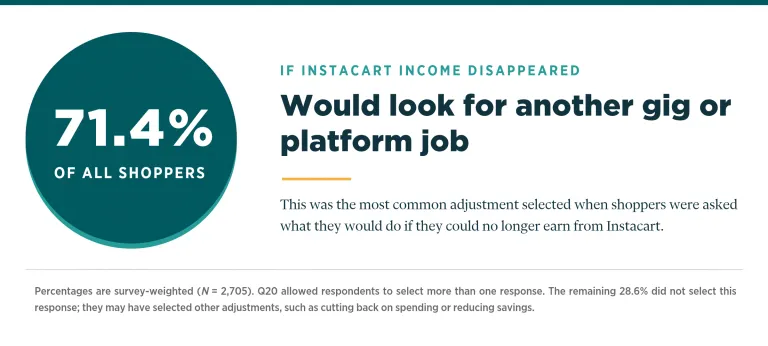
In a separate question, 71.4 percent of all shoppers say they would look for another gig or platform job if Instacart income disappeared. The relevant alternative for many shoppers is therefore another flexible arrangement—not a conventional job with fixed hours. For some, the alternative may be fewer hours of paid work or no additional earnings at all.
These responses do not establish exactly what every shopper would do if Instacart disappeared. They do, however, make one point clear: Reducing access to platform work would not automatically move most shoppers into traditional employment.
Instacart Generally Supplements Rather Than Replaces Traditional Employment
The before-and-after employment data point to a similar conclusion. Across all shoppers who held a traditional job before joining Instacart, 62.7 percent still hold one today. Among supplemental earners who held a traditional job before joining Instacart, that share rises to 77.6 percent, as figure 5 illustrates.
For these workers, Instacart appears to add flexible income around existing employment rather than replace their existing employment. The platform can fit around a full-time job, a part-time job, another source of self-employment, or household responsibilities.
A minority of workers use Instacart while looking for more stable employment, and some rely on the platform more heavily than others. But the typical shopper is not choosing between Instacart and a traditional job in a simple one-for-one decision. The work is often layered onto an existing economic life.
Flexible Platform Work May Expand Earning Opportunities for Caregivers and Older Workers
The pattern of using Instacart as one of several income sources is especially pronounced among caregivers and older shoppers.
Among shoppers who do not currently hold a traditional job, 44.6 percent of women with children—compared with 21.1 percent of women without children—say that family, school, or health circumstances make traditional jobs difficult. Among mothers who say Instacart allows them to work hours that traditional jobs typically would not offer, 56.2 percent cite family responsibilities as the reason those hours do not fit a traditional job, as shown in figure 6.
Shoppers age 65 and older show a related pattern. As figure 7 shows, they were the age group most likely to say that, if Instacart were unavailable, they would only consider work offering the same flexibility. Among these older shoppers, only 20.5 percent currently hold a traditional job, while 55.0 percent report being retired.
For some caregivers and older shoppers, flexibility appears to be a condition that makes paid work possible when conventional schedules do not fit. These findings suggest that platform work may expand the set of feasible ways for some people to earn income.
Supplemental Income Can Be Significant to a Household Budget
“Supplemental” describes where Instacart income fits relative to a worker’s other income sources. It does not describe whether that income matters.
Figure 8 shows the various ways shoppers use their income from the platform. Among supplemental earners, 51.9 percent say losing Instacart income would make it at least somewhat difficult to cover expenses. The income is commonly used for ordinary household needs: 64.0 percent report using it for at least one core expense, including food, housing, transportation, health expenses, or childcare and education. Another 47.0 percent use it for debt payments, savings or investments, or emergency-fund contributions. Indeed, after food (51 percent), making debt payments is the second-most-reported use of how workers spend their Instacart income (31.7 percent).
A worker may spend only a few hours on the platform and still rely on the income to smooth an irregular paycheck, pay a bill, preserve savings, or handle an unexpected expense. This is why the number of hours worked cannot, by itself, tell us how important platform income is to a household.
Policy Implications of the Survey Findings
The policy challenge is not simply to make platform work look more like traditional employment. Our results suggest that most shoppers are not looking to replace Instacart with a traditional job. Across the survey’s counterfactual questions, many would seek another gig or platform job, look for work only if it offered comparable flexibility, or not seek additional work at all. Reducing access to flexible platform work may therefore lead to another platform, fewer hours of paid work, reduced savings or spending, or no replacement earnings—not a direct shift into regular-hours employment.
At the same time, workers approach Instacart with different circumstances and needs. Some shoppers value greater security, including predictable earnings, job stability, benefits, training, or advancement. But the survey indicates that, for most shoppers, flexibility and the ability to work intermittently are central to why the arrangement works.
Most shoppers report having health insurance or other health coverage (80.8 percent). This coverage pattern suggests that workers differ in the forms of security they already have and the benefits they value. Evidence from economist Jonathan Gruber’s survey of Uber workers points in the same direction.4
These differences matter for how policymakers think about classification and benefits. Because Instacart work is often supplemental and involves relatively few platform hours, a single employee model may impose the costs of traditional employment without addressing every worker’s needs. Traditional benefits are often tied to full-time work, tenure, and a single employer—conditions that do not describe most shoppers in this sample. The policy question is therefore broader than extending one traditional employment benefit: A single legal status or set of benefits may not address every worker’s concern.
Platform-specific policies should address concrete risks while preserving access, scheduling control, and the ability to work intermittently. Broader workforce policies should address the separate problem faced by workers who want more hours or a transition to stable employment. The objective should be to expand workers’ opportunities, not narrow the range of work arrangements available to them.
Rules governing platform work can affect more than the amount paid for a completed task. They can also affect how many orders are available, how many workers can participate, whether workers can log on intermittently, and whether they can work during the times that fit their schedules.
A policy that raises pay per active hour but reduces access to orders or participation may not raise total income for the workers it is intended to help. It may also make the platform less useful to people who rely on occasional or intermittent work.
New York City offers a suggestive, though not causal, illustration of this tradeoff. Before-and-after data from the city’s restaurant-delivery sector show that average hourly earnings increased following implementation of the city’s original minimum-pay regime.5Over the same period, however, total worker hours fell 38 percent, on-call hours fell 72 percent, average hours per worker fell 21 percent, and the number of workers performing trips fell 21 percent, while deliveries increased by only 5 percent. These are descriptive changes—not evidence that the regulation caused each outcome—and may reflect other factors. They nevertheless show why policymakers should examine access to work and the number of participating workers alongside hourly pay.
Seattle provides stronger evidence on this question. A recent study compared delivery drivers in Seattle with similar drivers elsewhere in Washington before and after the city’s 2024 task-level pay standard.6It found that base pay per task increased, but average tips fell substantially. Among highly attached incumbent drivers, fewer tasks were completed, fully offsetting the higher pay per task and producing no increase in monthly earnings. Drivers also experienced more unpaid idle time and longer distances between tasks. The findings show that raising the posted rate for each task can coincide with fewer available tasks and no increase in workers’ overall monthly earnings.
The lesson is not that every pay standard will have the same result. It is that policy should be evaluated by its effect on the full set of ways workers can earn—not by the posted rate for an individual task alone.
Expanding the Ways People Can Earn
The debate over platform work often treats app-based work as a replacement for traditional employment. The evidence from Instacart shoppers points to a different reality.
For many shoppers, Instacart is a small but meaningful source of income layered around an existing job, caregiving, retirement, or another household responsibility. Its value lies not only in the amount earned, but also in the ability to work at times and for durations that conventional jobs may not accommodate.
That is why supplemental should not be confused with insignificant, and why reducing access to flexible platform work should not be assumed to move workers into traditional employment. Many platform workers would seek another flexible arrangement; others would work fewer hours or not seek additional work at all.
A sound policy approach should preserve flexible earning opportunities, address concrete risks, and use broader workforce policy to improve pathways for workers who want more stable employment. The goal should be to expand the ways people can earn—not to eliminate the arrangements that make earning possible for many workers in the first place.
About the Authors
Liya Palagashvili is a senior research fellow and director of the Labor Policy Project at the Mercatus Center at George Mason University, where her research focuses on labor markets, independent work, portable benefits, and how artificial intelligence is changing the nature of work. Her research has been cited in congressional hearings and the Federal Register and has informed federal and state legislation on independent workers and portable benefits. She has testified before several state legislatures and committees of the US Senate and House of Representatives. Palagashvili has also published in academic journals and books on political economy, public policy, and economics. Her writing has appeared in outlets such as The New York Times and The Wall Street Journal. She earned her PhD in economics from George Mason University.
Revana Sharfuddin is a research fellow with the Labor Policy Project at the Mercatus Center at George Mason University. Her research centers on labor economics, the evolving nature of work, and how labor markets can foster growth and mobility for workers with diverse backgrounds and needs. She studies how new technologies, particularly AI, diffuse through labor markets and reshape employment, wages, and job quality. Her research has been cited in congressional hearings, and she has testified before Congress on workplace AI adoption. She previously held research roles at the Hoover Institution, IZA Institute of Labor Economics, and the Cato Institute. She holds a BA in economics from George Mason University and an MA in development economics from Friedrich-Alexander-Universität Erlangen-Nürnberg.
Benjamin Glasner is a senior economist at the Economic Innovation Group and an affiliate of the Center on Poverty and Social Policy at Columbia University. He studies US labor markets, place-based policy, and the design of social programs. His research appears in the Journal of Labor Economics, the Journal of Public Economics, and Health Affairs. He holds a PhD in public policy and management from the University of Washington’s Evans School.
Notes
[1]Liya Palagashvili, Revana Sharfuddin, and Benjamin Glasner, “The Economic Importance of Flexible Income: Evidence from a Survey of App-Based Workers” (Mercatus Working Paper, Mercatus Center at George Mason University, November 2026). Unless otherwise noted, all data referenced in this brief are from the study's weighted survey of 2,705 active Instacart shoppers, fielded February 2–12, 2026, and linked to de-identified administrative records.
[2]Because respondents could report more than one arrangement, these categories are not mutually exclusive.
[3]Workers whose reported status and administrative hours did not align clearly were excluded from this specific comparison.
[4]Jonathan Gruber, “Designing Benefits for Platform Workers” (NBER working paper no. 29736, National Bureau of Economic Research, February 2022).
[5]New York City Department of Consumer and Worker Protection, “Restaurant Delivery App Data: October–December 2024,” accessed November 4, 2026, https://www.nyc.gov/assets/dca/downloads/pdf/workers/Restaurant-Deliver…. The comparison is descriptive, concerns restaurant-delivery apps rather than Instacart specifically, and may reflect other changes in the market.
[6]Yuan An, Andrew Garin, and Brian K. Kovak, “Delivering Higher Pay? The Impacts of a Task-Level Pay Standard in the Gig Economy” (NBER working paper no. 34545, December 2025).

