- | Housing Housing
- | Policy Briefs Policy Briefs
- |
Legalizing Manufactured Housing Requires Legalizing Starter Homes
State laws requiring equal treatment for manufactured housing are just the starting point
As housing affordability concerns grow, manufactured housing—housing built to the US Department of Housing and Urban Development’s preemptive building code (the HUD Code)—is increasingly catching policymakers’ attention. Since 2020, policymakers in 12 states have passed laws intended to make it easier to site this type of housing.1Manufactured housing is important in housing affordability discussions because it is meaningfully less expensive to build than site-built housing. But because manufactured housing competes on cost, the state laws requiring equal treatment with site-built housing can pay off only where land use regulations also allow for the construction of small, basic houses on small lots. Policymakers who want to make housing more affordable need to make starter homes in general—and therefore manufactured housing in particular—a straightforward option.
Manufactured housing’s cost advantage comes from a few sources. These include the HUD Code itself, which, relative to other US building codes, places a high priority on the affordability of manufactured housing. Additionally, factory construction and the scale of the industry create opportunities for cost savings, with less waste and more efficient production processes than are seen in site-built housing. Historically, a requirement that HUD Code housing sit on a permanent steel chassis—even if the unit is installed on a permanent foundation—has been a defining feature of manufactured housing. New federal legislation, however, directs HUD to update the code to eliminate that requirement.2That change will expand the cost advantage of manufactured housing and improve opportunities for its multistory and multiunit forms.
The cost advantages are greatest for the least expensive types of manufactured housing. Careful estimates of the cost of manufactured housing sited on a permanent foundation find that single-section manufactured housing costs 65 percent less than a site-built house of comparable size and quality after accounting for transportation and installation costs.3For double-section manufactured housing, the savings are 40 percent relative to comparable site-built housing. For CrossMod manufactured housing, a new type that includes site-built components such as a porch, a garage, and a steeper roof pitch, the cost savings are 27 percent. Larger and fancier additions to a basic manufactured house erode its cost advantages.
US Factory-Built Housing Terminology
|
About 17 million Americans live in manufactured housing.4Twenty-six percent of these households live in homes that are sited on land that they rent in manufactured housing parks.5These parks are a crucial source of low-cost housing in the United States.6Owned housing on rented land creates inherent insecurity, however, because the park owner could choose to sell the park.7Although residents who have lost their space in a park have the option to move their home to another location, doing so is expensive and can damage the home. Today’s manufactured housing is not intended to be moved from place to place, as was common for mobile homes built before the federal code that Congress enabled in 1976.8
The inherent instability of the lots available for manufactured housing in parks is one factor behind policymakers’ interest in adding more chances for manufactured housing to be sited on individually owned lots. Manufactured housing on standard lots, where the house and the land are jointly owned as real estate, provide an opportunity to take advantage of the cost savings of manufactured housing without the downsides of divided ownership. But many localities now have land use regulations that confine this housing to parks, ban it outright, or otherwise regulate where it can be used. So, although the HUD Code preempts state and local policymakers from adjusting the building requirements for these units, the owners cannot site the units except where local regulations allow them, if at all.
In the next section of this policy brief, I examine the landscape of state laws that address land use restrictions on manufactured housing. I also explore the relationship between these state laws and the prevalence of manufactured housing over time, finding that while equal-treatment laws allow for the use of manufactured housing where it would otherwise be banned, other exclusionary zoning rules can prevent its widespread use. In the final section, I analyze the potential to expand the places where manufactured housing might be viable through minimum lot size reform. Opening up more land to starter-home construction of all types can allow state protections for manufactured housing to reach their potential.
State Laws Protecting Manufactured Housing
Starting with Vermont in 1976, state policymakers have been passing laws intended to protect manufactured housing from local zoning exclusion. These state laws are an important step toward making it possible to reap the benefits of the low costs of manufactured housing in more places. Studies find that localities with more restrictive zoning see a lower share of manufactured housing as a portion of their total housing stocks and a lower share of manufactured housing loans.9In an analysis of land use regulations that block manufactured housing, legal scholar Daniel Mandelker writes, “Unequal treatment lies at the heart of zoning barriers to manufactured housing.”10He puts forward a model for state policy that requires fully equal treatment of manufactured housing and site-built housing under land use regulations. Research exploring new manufactured housing developments identifies cases in which local zoning rules specifically bar manufactured housing, leading developers to use more expensive factory-built homes built to a state code in these developments instead.11These case studies demonstrate that in some places, equal-treatment laws address specific barriers to manufactured housing that make the difference between them being a viable housing option or not.
In the map in figure 1, I distinguish between three categories of protections for manufactured housing. The states with the strongest laws align with Mandelker’s recommendations, both requiring localities to allow manufactured housing in any zone where site-built housing is allowed and preventing localities from adopting any design standards that apply specifically to manufactured housing. The second category includes states where laws require manufactured housing to be allowed anywhere that site-built housing is allowed but leave open the door to design standards that are specific to manufactured housing. And finally, 10 states have laws that require manufactured housing to be allowed in some residential zones outside manufactured housing parks, but not necessarily in all zones where site-built housing is allowed. Figure 1 shows that 31 states have laws protecting the right to use manufactured housing. The appendix has a table that provides more details.
Even where states have established equal treatment, exclusionary zoning that does not single out manufactured housing may make it unviable. Every zoning rule that adds to housing costs of any kind—such as minimum lot size requirements, design requirements that mandate complicated rooflines, or expensive siding requirements—stands in the way of starter home construction of all types.12If a community has zoned out starter homes, it has zoned out manufactured housing.
Three recent analyses examine the relationship between land use regulations and the prevalence of manufactured housing. One finds that local zoning restriction and growth containment policies reduce manufactured housing share. It includes a control for state protections for manufactured housing against local zoning exclusion as of 2006 and finds that states with more protections see slightly less concentration of manufactured housing.13
The second analysis develops a model for the likely prevalence of manufactured housing across states on the basis of their economic and demographic factors. It finds that states with strong zoning protections for manufactured housing are as likely to fall short of their expected share as to exceed it. The author writes, “There is almost no relationship between state equal-treatment laws and [manufactured housing] shares, after controlling for income, population density, and climate.”14These studies cannot be interpreted causally because equal-treatment laws may be adopted in states where exclusionary zoning is a particular problem.
The third recent analysis examines the prevalence of manufactured housing at municipal borders, finding that manufactured housing is more prevalent on unincorporated county land where the author posits that zoning is likely to be more liberal relative to cities.15This study provides evidence that local exclusionary zoning rules—such as lot size minimums and aesthetic mandates—in fact do shut out manufactured housing.
Data are available on inbound manufactured housing shipments by state16and private housing units permitted locally for the period from 1994 to 2025.17Using these data, I look at trends in the three states that adopted the strongest category of manufactured housing zoning protection during that time period: Utah in 1996, Washington in 2005 (law passed in 2004), and New York in 2015. Kentucky’s law passed in 2024 but wasn’t implemented until 2025, so it is not included here.
The charts in figure 2 show these states’ ratio of new manufactured housing units to privately owned housing units authorized by building permits. These time-series data do not provide visual evidence that any of these states saw a substantial increase in their manufactured housing shares after the implementation of these laws.
The charts in figure 3 show these states’ annual manufactured housing shipments relative to national manufactured housing shipments, with both series indexed to 100 in the year before the state’s implementation of its manufactured housing zoning protection. None of these states saw large or sustained shifts toward manufactured housing development following adoption of strong zoning protection. Equal zoning treatment for manufactured housing may be a necessary but insufficient policy for making it feasible to use.
Regional Case Studies: Manufactured Housing and the Cost of a Lot
Manufactured housing competes with site-built housing on cost efficiency. Every regulation that adds a flat cost to each unit of housing, whether it is a larger minimum lot size requirement or a requirement for an expensive siding material, reduces the cost advantage of manufactured housing relative to the final sale price. In places where land is more expensive, the added cost is larger in percentage terms for manufactured housing relative to more expensive site-built housing.18
In a survey of local officials on the ease of siting manufactured housing in their communities, 42.4 percent of respondents said that high land prices were a significant barrier or a factor that could completely prevent HUD Code homes in their community.19They indicated land prices as a barrier more frequently than any of the regulatory barriers surveyed, including zoning codes, subdivision regulations, and design standards. But local land use regulations are a key piece of the equation that determines the cost of land for a new manufactured home sited on a single-family lot—the area’s per-acre land values divided by the acreage required for each unit. Although local policymakers have very limited control over their jurisdiction’s per-acre land costs, they determine how much acreage is required for each house by setting the minimum lot size requirements.
In turn, minimum lot size requirements and the land costs they mandate determine the types of housing that are economically viable to build. Developers often use a rule of thumb that the cost of land with utilities should make up about one-third of the final sale price of a new-construction house.20Land costs indirectly dictate the size and fanciness of new houses because homebuilders build to the highest and best use that land use regulations and market conditions allow. If land use regulations allow only single-family houses but the demand for housing and land prices are very high, homebuilders will build large houses with high-end finishes.
Combining data on land values with data on local minimum lot size requirements presents an opportunity to identify where manufactured housing is currently an economically viable option—and where it could be if zoning were reformed to allow for smaller, less expensive lots. For data on land values, I use Federal Housing Finance Agency (FHFA) 2020 estimates at the ZIP Code level, which FHFA standardizes to one-quarter-acre lots to account for smaller lots typically being worth more than larger lots on a per-acre basis.21
To illustrate the importance of minimum lot size requirements in determining where it is feasible to site manufactured housing—or, alternatively, to develop site-built starter homes—I use data collected for the National Zoning Atlas (NZA) that I have access to for three example regions: Middle Tennessee (the Nashville region); Hampton Roads, Virginia; and Northern Virginia.22I adjust the FHFA’s price estimates for one-quarter-acre standardized residential lots up or down depending on the minimum lot size requirement’s deviance from one-quarter acre. For example, if a zone has a one-half-acre minimum lot size requirement, I double the FHFA lot price estimate. I merge the ZIP Code–level FHFA data with the zone-level NZA data, using a weighted average of ZIP Code land value when multiple ZIP Codes intersect a zone.
To identify a land price where I think manufactured housing is economically viable, I use a cost estimate of $94,000 for a new single-section manufactured home, including all costs except for land for these regions.23Following the general rule of thumb that land prices should make up about one-third of a house’s sale price, I establish a target lot cost of $47,000 for manufactured housing. I flag places where this adjusted value is less than or equal to $47,000 as places where the costs could support manufactured housing subdivisions under current lot size requirements.
Then I adopt the assumption that single-section manufactured houses could be sited on lots as small as one-sixteenth of an acre, a little more than 2,500 square feet. Allowing houses to sit on lots this small would be a big departure from what is currently allowed on almost any of the land in the three metro areas where I have zoning data. Under current zoning, the area-weighted median minimum lot size requirement in areas with water and sewer access is 0.34 acres in Northern Virginia, 0.23 acres in Hampton Roads, and 0.57 acres in Middle Tennessee. The United States is a global outlier in terms of the land it requires for each house and the low densities that result.24
It’s very reasonable for a manufactured house to sit on a lot of just 2,500 square feet.25We can imagine subdividing a typical 5,000-square-foot or 10,000-square-foot lot into two or four 25-feet-wide by 100-feet-deep lots. A 15-foot by 80-foot single-section home could fit on this lot with 5-foot side setbacks and 10-foot front and rear setbacks. Some cities already allow smaller lots in their mobile home parks.26
To adjust land prices for one-sixteenth-acre lots, I divide the land value estimates that come from the FHFA data by three, recognizing that smaller lots command a premium relative to larger lots and that some lot costs are fixed, including utilities.27Unlike the current-zoning estimate, this reform estimate does not incorporate the zone’s existing minimum lot size.
This crude approach does not capture the wide range of real-world land values that would result from a major regionwide reduction in minimum lot size requirements. An actual reform of this nature would have disparate effects on land prices across a metro area.28A hypothetical upzoning of a small area in a supply-constrained region would likely raise that area’s land value by increasing the option-value of that land. A much broader upzoning might lead to higher per-acre prices in areas close to jobs and amenities as redevelopment becomes a more attractive option. In the long run, the resulting new supply of housing closer to job centers may lower land values in the exurbs (where manufactured housing development is most likely to be located), as more central housing alternatives become options. My rough estimate serves to illustrate just how much minimum lot size requirements affect where low-cost housing can be viable.
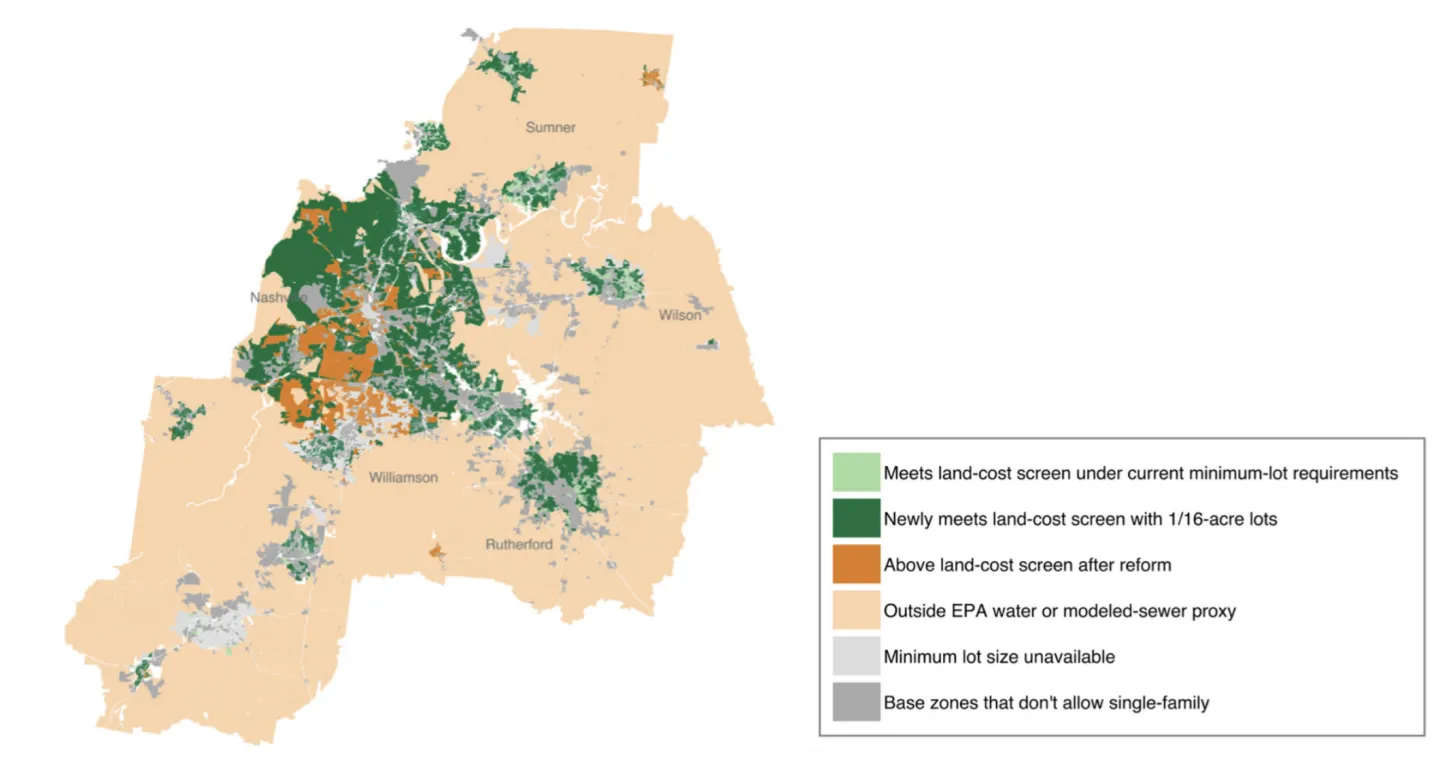
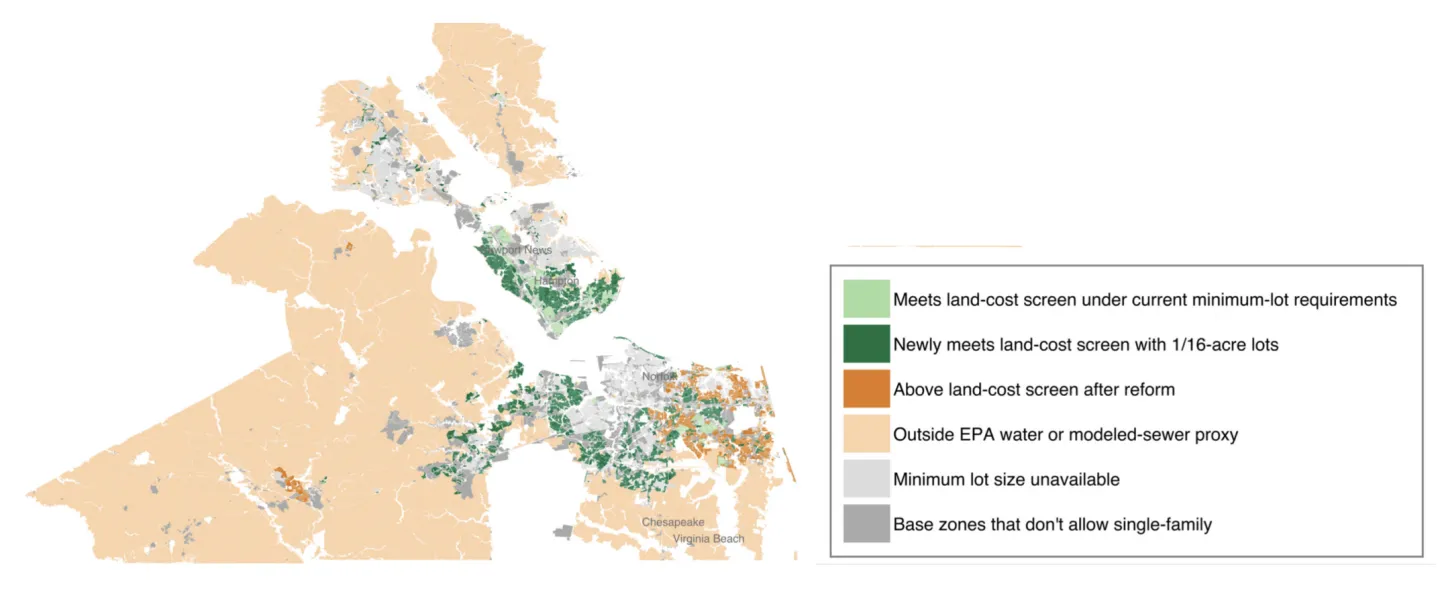
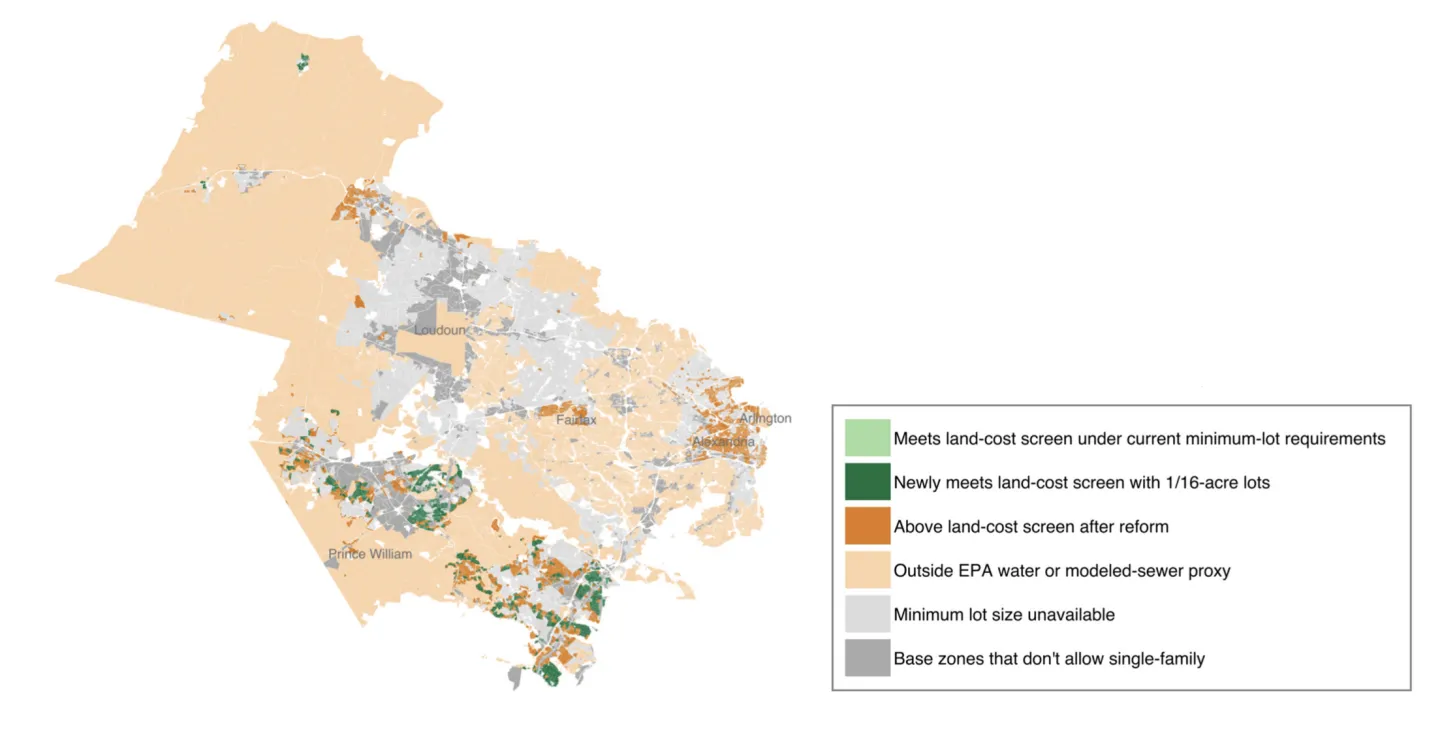
The maps in figures 4, 5, and 6 show the three regions for which I have data on land values and minimum lot size requirements. The maps show, in light green, where land is available at current values and zoned minimum lot size requirements under the $47,000 threshold; in dark green, where land would be available under the naive calculation of one-sixteenth-acre minimum lot size requirements; and in orange, where land prices would remain too high to support single-section manufactured housing under reform. I include a proxy variable for water and sewer utility availability, which would be necessary to support this small-lot development.29Land that is unviable for manufactured housing development because of lack of sewer and water access is shown in peach.
In some cases, a single numerical value for a zone’s minimum lot size is not available because requirements vary according to whether the lot has sewer and water access, whether the lot is on a corner, or other factors. In these cases, light gray is used to indicate that it is unknown whether the areas meet the cost threshold for manufactured housing development. Land where single-family housing is not permitted is shown in dark gray.
FIGURE 4. Middle Tennessee single-section manufactured housing viability
Note: Data from National Zoning Atlas (see note 22), the Federal Housing Finance Agency (see note 21), and the Environmental Protection Agency (see note 29).
FIGURE 5. Hampton Roads single-section manufactured housing viability
Note: Data from National Zoning Atlas (see note 22), the Federal Housing Finance Agency (see note 21), and the Environmental Protection Agency (see note 29).
FIGURE 6. Northern Virginia single-section manufactured housing viability
Note: Data from National Zoning Atlas (see note 22), the Federal Housing Finance Agency (see note 21), and the Environmental Protection Agency (see note 29).
In each region, reducing land costs through minimum lot size reform could drastically expand the land area where manufactured housing is viable on individual lots. Under my assumptions, in Middle Tennessee, the total zoned land area where land could meet the cost threshold for manufactured housing expands from 0.77 percent to 12.77 percent. In Hampton Roads, it expands from 0.89 percent to 5.26 percent. In Northern Virginia, it expands from 0.02 percent to 1.80 percent. Under a hypothetical minimum lot size reduction to one-sixteenth of an acre, only a tiny fraction of land where manufactured housing could make economic sense would actually be developed with manufactured housing subdivisions. These estimates rest on a lot of assumptions that could each be challenged in either direction, but they illustrate the extent to which local land use regulations are holding back this low-cost option and starter homes of all types.30
In addition to minimum lot size reform, other zoning changes could facilitate similar changes to land use economics that would make it feasible to use manufactured housing in more cases. Where zoning allows for multiple units on a single lot, the HUD Code’s recent changes allow for up to four attached manufactured housing dwellings.31A fourplex on a 10,000-square-foot lot would have similar viability to a single-unit dwelling that’s one-quarter of the size on a 2,500-square-foot lot. Additionally, HUD has a proposed rule that would allow for multistory manufactured housing units with no chassis on the upper floor unit.32This proposal provides an alternative path to multistory manufactured housing relative to the forthcoming general reform eliminating the chassis requirement in states that implement this option. Two-story or three-story homes would be feasible to build on more expensive lots than single-story homes.
Conclusion
Statewide laws that prevent zoning discrimination against manufactured housing are an important first step toward reducing regulatory barriers for low-cost construction. In some instances, these rules will make manufactured housing development feasible where local zoning would otherwise have blocked it. As the maps in this policy brief show, however, exclusionary zoning rules that don’t target manufactured housing may nonetheless make it an unviable option. To make a big difference in opportunities to use low-cost construction, policymakers must further liberalize land use regulations. Drastically reducing minimum lot size requirements is the place to start.
About the Author
Emily Hamilton is a senior research fellow and director of the Urbanity Project at the Mercatus Center at George Mason University. Her research focuses on urban economics and land-use policy. She publishes both academic research and policy work. Her writing has appeared in outlets including The Washington Post and the Los Angeles Times, and she writes an occasional column at Governing. Hamilton has testified before several state legislatures as well as the US House of Representatives. Hamilton serves on the advisory boards of Up for Growth and Cityscape, a journal published by the Department of Housing and Urban Development. She received her PhD in economics from George Mason University and is an alumna of the Mercatus MA Fellowship.
Acknowledgments
Thank you to Joseph Caso for research assistance on this policy brief and to Salim Furth and Seva Rodnyansky for their helpful comments on an earlier draft. I used OpenAI tools for some of the data compilation and code writing required to complete this research. Any errors are my own.

